The Challenge of Preserving Maharashtra’s Greatness
Lord Ganesha is revered as the remover of obstacles. Therefore, during the Ganesh festival, people from Maharashtra’s political and social spheres must surely be praying that the obstacles facing the state are removed. But this year, Maharashtra’s challenges are not confined merely to inadequate rainfall, drought or agitations. The state’s future economic and administrative trajectory will also be put to the test.
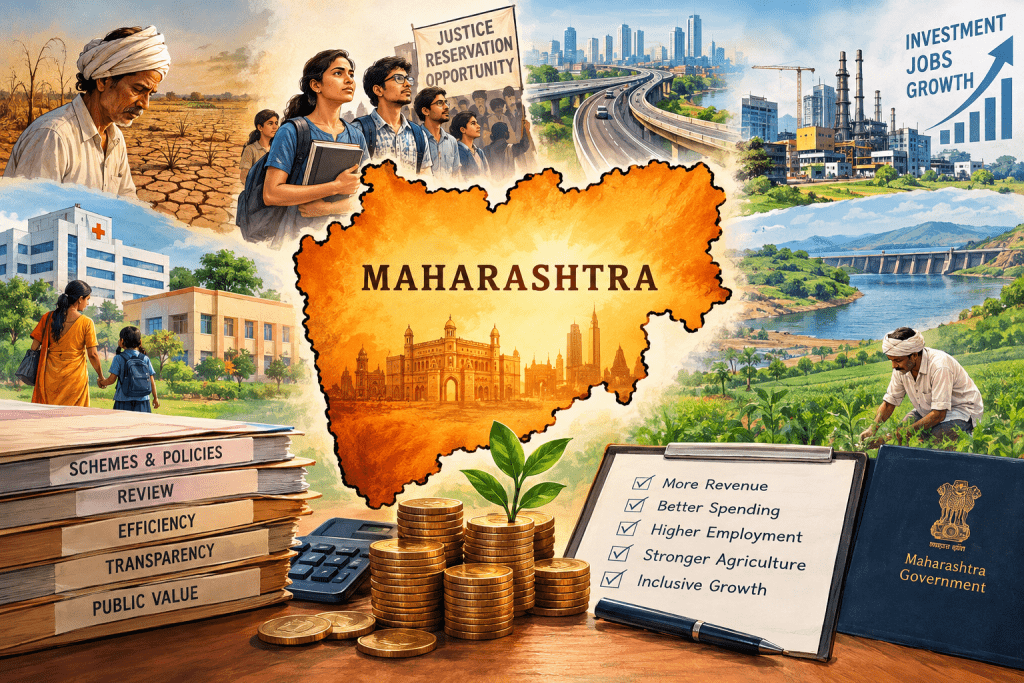
In some parts of the state, inadequate rainfall has created the threat of drought. The government will have to undertake large-scale measures to deal with the situation. At the same time, agitations demanding a rethink of some government policies are continuing. The issue of Maratha reservation periodically returns to centre stage. Students and competitive examination aspirants continue to express their anger over the functioning of the Maharashtra Public Service Commission. The concerns of farmers, government employees, tribal students and other sections of society too keep surfacing through protests.
Economic Management Is the Key Issue
Beyond all these challenges lies one issue that has received relatively little public discussion, but which could have a major impact on the state’s administration in the years ahead. That issue is financial management.
Recently, the state Cabinet decided to establish an institution called ‘Maha-TAC’ to review 25 major government schemes and policies. Subsequently, the Maharashtra Sustainable Public Finance Committee was constituted under the chairmanship of Dr Vijay Kelkar. Its principal tasks include increasing the state’s revenue, making tax collection more efficient and undertaking a comprehensive study of public finances.
In one sense, both decisions provide the state government with an opportunity to take a fresh look at its own functioning. But a fundamental question arises: Why does the government have to wait until after schemes and policies are implemented to review them?
Shouldn’t There Be a Study Before Launching Schemes?
An elected government formulates policies and the administration implements them. However, before launching any scheme, its long-term financial implications, expected benefits, alternative costs and the state’s fiscal capacity must be adequately assessed. Alongside the political and social impact of schemes such as Ladki Bahin, Shetkari Sanman Yojana or pilgrimage-related programmes, their financial liabilities too need to be carefully examined.
If, after a scheme has been launched, the government finds it necessary to establish an independent institution to determine how many people have benefited, how much money has been spent and whether the objectives have been achieved, then it must be acknowledged that a much more rigorous evaluation was required at the decision-making stage itself.
Earlier too, the Tata Institute of Social Sciences had been entrusted with studying schemes and budgetary allocations of certain departments in the state. A report was submitted. However, how far it actually resulted in expenditure reduction or restructuring of schemes is a matter that needs independent examination. This time too, care must be taken to ensure that the exercise does not merely produce another report that eventually gathers dust in a government file.
What Sustainable Value Is Being Created Through Public Spending?
The issue becomes even more serious when Maharashtra’s financial position is taken into account. The state’s debt is rising. Government guarantees are extended to institutions such as the Maharashtra State Road Development Corporation and the Mumbai Metropolitan Region Development Authority to enable them to raise loans for infrastructure projects. The burden of such guarantees and future liabilities ultimately falls on the state exchequer.
Therefore, the key question today is not merely ‘How much has been spent?’ but rather, ‘How much public value has been created through every rupee spent?’
Fiscal discipline does not mean across-the-board cuts in expenditure by every department. It also means shifting funds from low-priority expenditure to more important sectors, obtaining better outcomes from recurring expenditure and curbing unnecessary spending. Significant savings can also be achieved by exercising restraint in expenditure on government buildings, official residences, office renovations, unnecessary repairs and other cosmetic or non-essential expenses. But that requires political will.
Revenue mobilisation presents another important challenge. Increasing tax rates and placing an additional burden on ordinary citizens cannot be the only way to increase revenue. It is more important to identify revenue leakages, outstanding dues and structural weaknesses in the existing tax system across major sources such as GST, excise duty, stamp duty, registration fees and motor vehicle tax.
Royalties applicable on mining, user charges, various fees, dividends from public-sector undertakings, income from government properties and more efficient management of government land can also serve as alternative sources of revenue.
In particular, government land leases require a comprehensive review. For what purpose was land allotted? At what rate? How many leases have expired? At what rates should they be renewed? And what should be done with land where lease conditions have been violated? An objective assessment of these questions could provide a significant boost to the state’s revenues.
The State Needs to Review Incomes and Industrial Investment
However, increasing revenue should not simply mean increasing tax collection. The best way to strengthen the state’s economy is to increase the earning capacity of its citizens. That requires greater employment generation, industrial investment, agricultural productivity and a stronger rural economy.
Maharashtra is frequently projected as a major destination for investment. The crucial questions, therefore, should be part of the public debate: How many jobs have these investments actually created? How much have they contributed to the state’s revenues? And what impact have they had on balanced regional development?
Agriculture offers an even more telling example. Despite various subsidies and government schemes for agriculture, if farmers are still unable to obtain remunerative prices for their produce and their incomes remain stagnant, the answer is not necessarily to keep adding more schemes. What matters is assessing the actual impact of existing schemes. Such an assessment should be one of the expectations from Maha-TAC.
Ultimately, the state’s fiscal health revolves around three fundamental questions: Where does the money come from? Where is it spent? And how much public value is created through that expenditure? Sustainable financial management is impossible without finding integrated answers to all three.
If the committee headed by Dr Kelkar undertakes an objective and comprehensive study and provides the government with a clear direction, it could mark an important turning point for Maharashtra. But the action taken on the report will matter far more than the report itself.
Maharashtra has established its position as one of India’s major economic states. That position cannot be sustained merely through large projects or grand announcements. The state’s real strength will depend on disciplined use of public money, a robust revenue system, rising employment and increasing incomes for its citizens.
The challenge before Maharashtra today is not merely to generate more money. It is also to use the money it already has more wisely.