
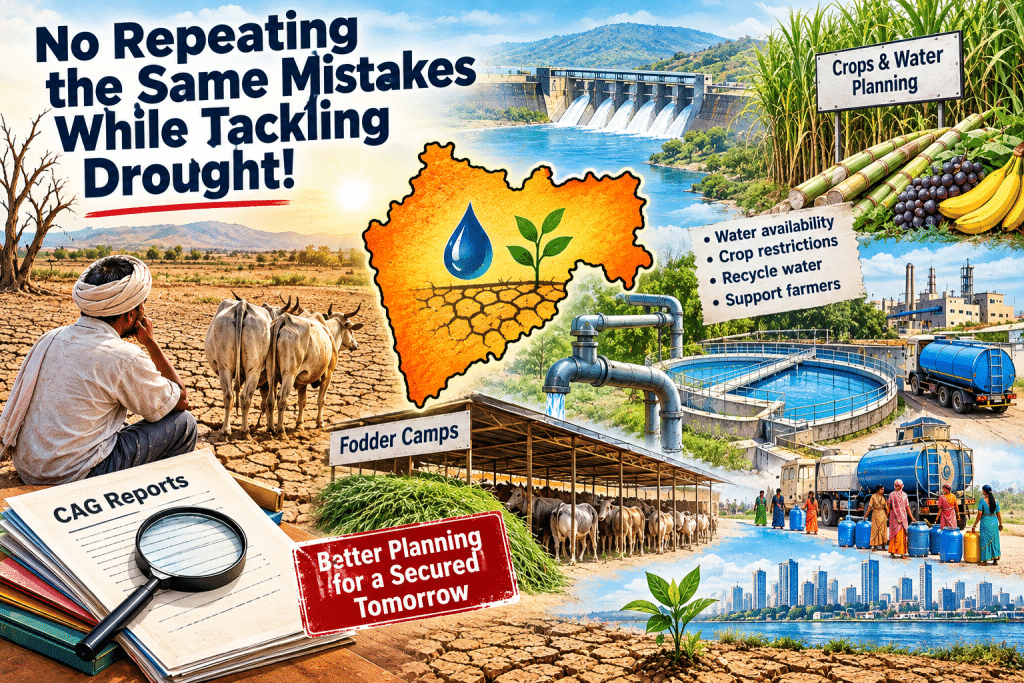
No Repeating the Same Mistakes While Tackling Drought!
In parts of Maharashtra, four consecutive good monsoons are often followed by a deficient one. There is nothing particularly unusual about this. Experts and the government machinery are well aware of the pattern. Everyone also knew that this year could be affected by El Niño. Yet our fatalistic approach teaches us to live on hope. The preparations that should have been made before the monsoon began were not made.
The availability of fodder is one striking example. Fodder shortages are a recurring feature during droughts. The government has now decided to give priority to fodder cultivation. Had the same planning been undertaken at the beginning of the monsoon, fodder would have been available by now. Instead, preparations are beginning as the monsoon draws to a close.
A new system for declaring drought- referred to officially as deficient rainfall- has been in place for the past few years. Under this system, the first and second triggers have to be invoked. When the first trigger was announced, 265 talukas were declared drought-affected. Those familiar with the system point out that this could have been done in stages. September 30 is generally treated as the end of the monsoon, but that consideration appears to have been overlooked while announcing the list of 265 talukas.
The timing also coincided with the announcement of the schedule for elections to Legislative Council constituencies representing graduates and teachers. Since almost everything in politics now seems to revolve around elections, the inclusion of a large number of talukas inevitably invited political interpretations. Thereafter, efforts began to ensure that the remaining talukas were also included. This competition is unlikely to end soon.
The important question now is: how many talukas will qualify under the central criteria when the second trigger is considered? According to those familiar with the situation, the number may not cross 50. But by then, it may no longer be possible to reverse the political momentum created around drought declarations. The number of drought-hit talukas could cross 300, leaving the government machinery with the enormous task of addressing the consequences.
Politics Needed to Be Kept Aside
Officials’ leave has been cancelled. Water planning has begun. Restrictions on construction activity are likely. That would mean a slowdown in a sector that provides daily employment to thousands. Those affected may inevitably have to leave their villages and towns in search of work.
The real crisis during a drought, however, is faced by dryland agriculture and the farmers dependent on it. The livelihoods of those without irrigation remain at the mercy of the rains. When rainfall is adequate, they make provisions for the entire year. When drought strikes, the question becomes one of survival.
Farmers with irrigation facilities generally earn reasonably well in normal years and are able to save for difficult periods. They therefore face relatively fewer difficulties during a drought. Yet our system requires assistance to both dryland and irrigated farmers.
What can one do? That’s politics.
Parts of Marathwada and Vidarbha receive reasonably good rainfall from the retreating monsoon. Rabi sowing in these regions takes place around the middle of November, depending substantially on that rainfall. If the retreating monsoon fails, the government could face the twin problems of drinking-water shortages and reduced foodgrain availability.
Water Planning Is the Key Issue
The government will have to plan carefully which crops can be cultivated in the coming months. Given current storage levels, water-intensive crops cannot be permitted indiscriminately. The crucial question is whether water in irrigation projects should be made available for such crops or reserved for drinking water until the next monsoon.
The irrigated-farming lobby is powerful and carries considerable political weight. If political considerations prevent restrictions on crops such as sugarcane, grapes and bananas, it is difficult to ignore the consequences that could emerge by the time the next monsoon arrives.
Those who wish to cultivate water-intensive crops will have to be told clearly that they must first make arrangements for their own water requirements.
By November, almost all sugar factories will begin their crushing season. Sugar factories themselves require substantial quantities of water. Yet water recycling remains a neglected issue. Making water recycling mandatory for industries that consume large quantities of water deserves serious consideration.
Many sugar factories also engage in ethanol and alcohol production, which requires additional water. The government will therefore have to confront a basic contradiction: how to protect drinking-water supplies through the summer while meeting the water requirements of industrial units.
Water from several dams also has to be reserved for cities. The effects of a deficient monsoon will be felt in urban areas as well. If water reserved for agriculture has to be diverted to cities, the situation will become still more difficult.
Before the monsoon began, priority should have been given to assessing the condition of drinking-water schemes in villages and cities, identifying leakage, examining distribution networks and taking measures to rectify deficiencies. Had this been done in advance, every available drop could have been used more efficiently.
While roads, flyovers and underpasses are being prioritised in the name of infrastructure, these basic requirements also deserve serious attention. Infrastructure projects are being undertaken on a large scale. It would be prudent to consider now what the situation would look like if some of these projects had to be slowed or halted because of a shortage of water.
Fodder Camps: A Recurring Controversy
Saving livestock during a period of scarcity is another major responsibility. Over the past two or three decades, fodder camps have repeatedly become contentious for various reasons.
During the Congress-Nationalist Congress Party (NCP) government, fodder camps, the number of animals housed in them and the disposal of dung were among the issues closely monitored by the BJP. When the names of prominent Congress leaders from Vidarbha appeared in a CAG report, the BJP used the issue to target the government. Fodder camps were investigated and reports submitted, while leaders associated with their operation became the subject of criticism.
During the drought-like conditions of 2019, an app was used to record fodder camps and the number of animals housed there on a daily basis. The system was introduced during the tenure of Chandrakant Patil, then Revenue and Relief Minister. The app was not developed by the government itself, but its use was intended to improve monitoring and reduce the scope for manipulation.
In the spirit of “everyone loves a drought”, everything from digging borewells to running fodder camps, deploying water tankers and distributing relief becomes a subject of discussion- and often controversy.
The bottled-water business is currently expanding and also consumes substantial quantities of water. How this sector should be regulated during a water crisis will be another important issue. Similarly, the growing use of RO-based water purifiers deserves attention because of the quantity of water that can be wasted in the purification process.
CAG Reports That Made Headlines but Got Stuck in Files
Whether the disaster is drought or excessive rainfall, disaster management and relief become sensitive issues. The Comptroller and Auditor General (CAG) has produced several reports on these subjects.
An audit report on relief operations in Mumbai and parts of western Maharashtra during the 2005 floods received considerable attention. The issue of widening, deepening and desilting the Mithi River has remained relevant ever since.
Several CAG reports concerning irregularities in disaster management and the distribution of relief have made headlines. In one such case, the CAG called for action and a committee of secretaries was appointed. Based on its recommendations, a proposal was reportedly prepared for registration of a criminal case. Over time, however, the file disappeared from public attention.
Droughts and excessive rainfall keep returning. So does the issue of disaster preparedness. Yet instead of scrambling afresh every time a crisis strikes, the real question is whether we are willing to prepare in advance when we already know that the crisis is coming.
The only expectation is simple: while tackling drought, let us not repeat the same mistakes all over again.
————————————————————————————