
Want to Be Chief Minister? What Did You Say?
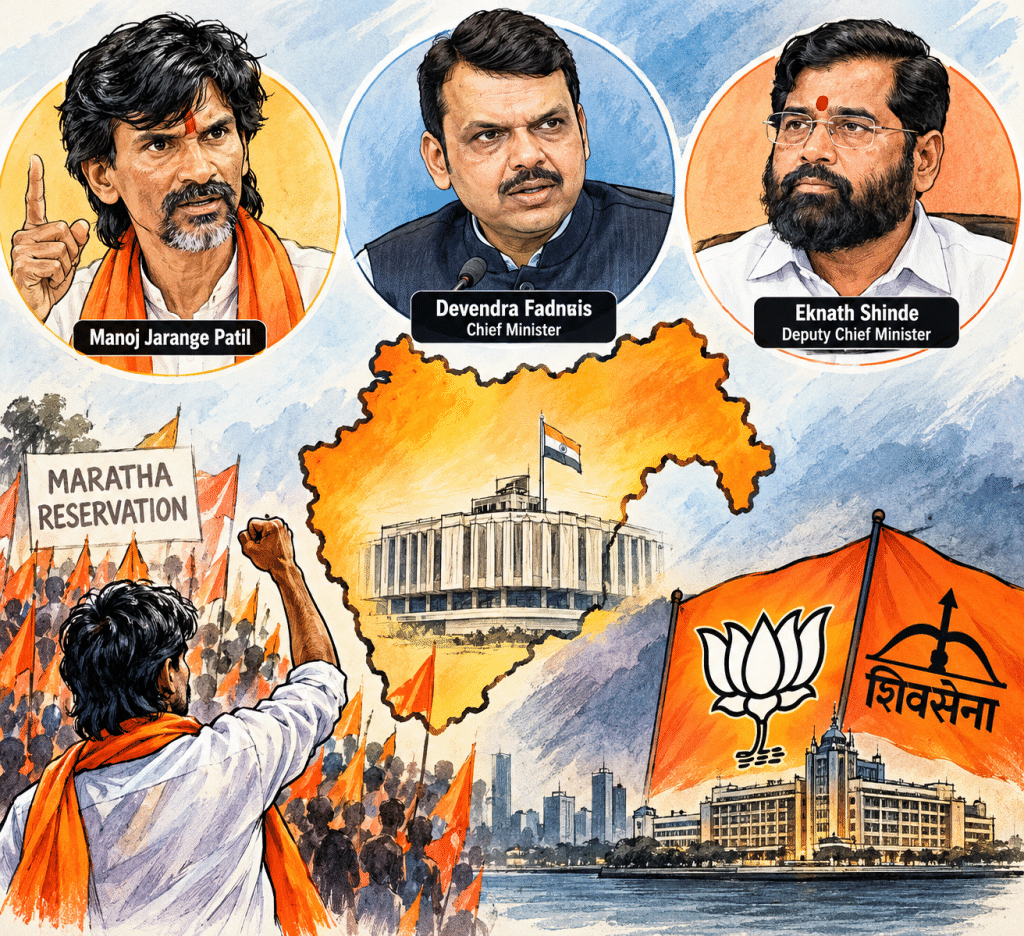
As staunch supporters of Shiv Sena leader Eknath Shinde rally behind his bid to return as Chief Minister, fresh allegations by Maratha reservation activist Manoj Jarange-Patil have added some intrigue to the current political scenario in Maharashtra. The central question is whether Shinde’s ambition can overcome the BJP’s long-term strategy for retaining and expanding its control over the state.
In politics, a leader rarely lacks friends and well-wishers until the question of who should occupy a particularly important post arises. Once a claim is staked, it becomes difficult to distinguish genuine backing from attempts to exploit an opportunity. Maharashtra’s current political developments illustrate this dilemma.
Former Minister of State and Prahar chief Bacchu Kadu joined the Shiv Sena and openly expressed his desire to see Shinde return as Chief Minister. Ministers such as Pratap Sarnaik, Gulabrao Patil and former minister Ramdas Kadam subsequently made statements supporting his claim. Their remarks raise a question: Are these spontaneous expressions of loyalty, or do they reflect a calculated political strategy?
Jarange’s Allegations and Changing Equations
The debate took a new turn when Jarange-Patil raised questions about an alleged Rs 500-crore transaction between him and Shinde. He asked Shinde whether he told senior BJP leaders that amount was paid to him. And whether it had supposedly been routed through Lok Sabha MP Shrikant Shinde.
At a press conference on Thursday, Jarange played an audio recording of a meeting, presenting it as evidence of the discussion surrounding the alleged transaction. The BJP and Eknath Shinde are now expected to respond to the claims.
Jarange’s relationship with Shinde has also attracted attention in recent months. His earlier suggestion that he helped Shinde during the elections, followed by an indication that he might support Uddhav Thackeray, prompted speculation about a possible political realignment. The debate has revived questions about how the Maratha reservation agitation influenced voting patterns during the 2024 Lok Sabha and Assembly elections.
The agitation mobilised Maratha youth but also heightened unease within the OBC community over reservation. The extent to which these competing concerns affected electoral outcomes, and how the Mahayuti benefited, remains contested.
More recently, allegations concerning investigations involving people close to Jarange and their business investments have added another dimension to the controversy.
Shinde’s associates have responded sharply. Ramdas Kadam, Uday Samant and Bharat Gogawale criticised Jarange, while BJP leader Chandrashekhar Bawankule questioned why the BJP was being drawn into the matter.
Shinde denied the allegations and challenged Jarange to produce evidence, calling for an investigation if such evidence existed. He also warned against turning the Maratha reservation agitation into a political platform.
His response raises a broader question: Is the controversy being used to advance a political agenda? While the opposition may struggle to extract a clear advantage from the allegations, their implications for the Mahayuti could be more significant. The issue is not simply whether the claims can be substantiated, but how the resulting political fallout might affect the alliance’s internal balance.
Shinde’s Ambition and the BJP’s Calculations
Speculation that Shinde wants to return as Chief Minister has intensified, fuelled by his visits to Delhi and meetings with senior BJP leaders. However, there is no official clarity on whether the Chief Minister’s post has featured directly in these discussions.
Shinde’s supporters argue that the 2024 Assembly elections were fought under his leadership and that he played a significant role in the Mahayuti’s victory. They also point to the Mukhyamantri Majhi Ladki Bahin Yojana, through which he sought to reach women voters. Although the scheme’s precise electoral impact remains a matter of debate, his supporters regard his leadership as central to the alliance’s success.
The BJP, however, must weigh these arguments against its own political ambitions.
Maharashtra’s economic importance and electoral weight make control over the state government a major strategic consideration. The BJP has an incentive to retain the Chief Minister’s post for itself or entrust it to a leader it considers dependable. Shinde’s apparently stronger ties with the BJP’s central leadership in Delhi than with its state-level leaders have further fuelled speculation about the relationship.
The BJP must also balance cooperation with its allies against its ambitions to expand independently, while managing the influence of Sharad Pawar, Uddhav Thackeray and the Congress. For Shinde, the challenge is to secure a greater role without undermining the alliance on which his political position depends.
Why Seek the Chief Minister’s Post When You Already Hold Power?
Shinde already controls important portfolios, including Urban Development and Housing. His influence extends to major institutions and projects such as the Mumbai Metropolitan Region Development Authority (MMRDA), the City and Industrial Development Corporation (CIDCO), the Maharashtra Housing and Area Development Authority (MHADA), the Shivshahi Punarvasan Prakalp and various municipal corporations, including Mumbai, Thane and Navi Mumbai.
These responsibilities provide substantial administrative influence and opportunities to shape development decisions, even without the Chief Minister’s title.
Yet the post carries significance beyond its formal powers. It offers greater control over government priorities, more direct influence over appointments and decision-making, and an opportunity to strengthen the party organisation. For Shinde, becoming Chief Minister again could help consolidate the Shiv Sena’s independent political identity ahead of future elections.
There is also a longer-term concern. The BJP appears intent on contesting the 2029 Assembly elections independently and securing power in its own right, a goal its leaders have publicly discussed. If that strategy advances, the Shiv Sena’s position within the alliance could change substantially.
Shinde’s demand for the top post may therefore reflect not only his immediate political ambitions but also a desire to safeguard his party’s future relevance.
Ambition or Strategy?
Maharashtra’s current political contest is ultimately about more than the Chief Minister’s chair. Shinde’s supporters are asserting his claim on the strength of his leadership and electoral contribution, while the BJP must weigh the demands of its ally against its own expansion plans. Reconciling these competing interests will test the Mahayuti’s cohesion.
Jarange-Patil’s allegations have added uncertainty to an already delicate equation. The evidence, the outcome of any investigation and the responses of the leaders concerned will determine the controversy’s credibility and consequences. Its impact on the debate over the Chief Minister’s post remains equally uncertain.
The immediate questions are straightforward: Eknath Shinde wants to become Chief Minister again, but is the BJP prepared to support him? And how should the Mahayuti respond to Jarange-Patil, who commands considerable support among Maratha youth and has levelled serious allegations against both the BJP and the Shiv Sena?
These questions are interconnected. The answers will shape not only the alliance’s internal power-sharing arrangements but also the Shiv Sena’s standing in a state where the BJP is seeking to strengthen its independent position.
Shinde’s ambition and the BJP’s political calculations are now on a collision course. Whether the two can be reconciled will help determine the next chapter of Maharashtra politics.
—————————————————————————–