
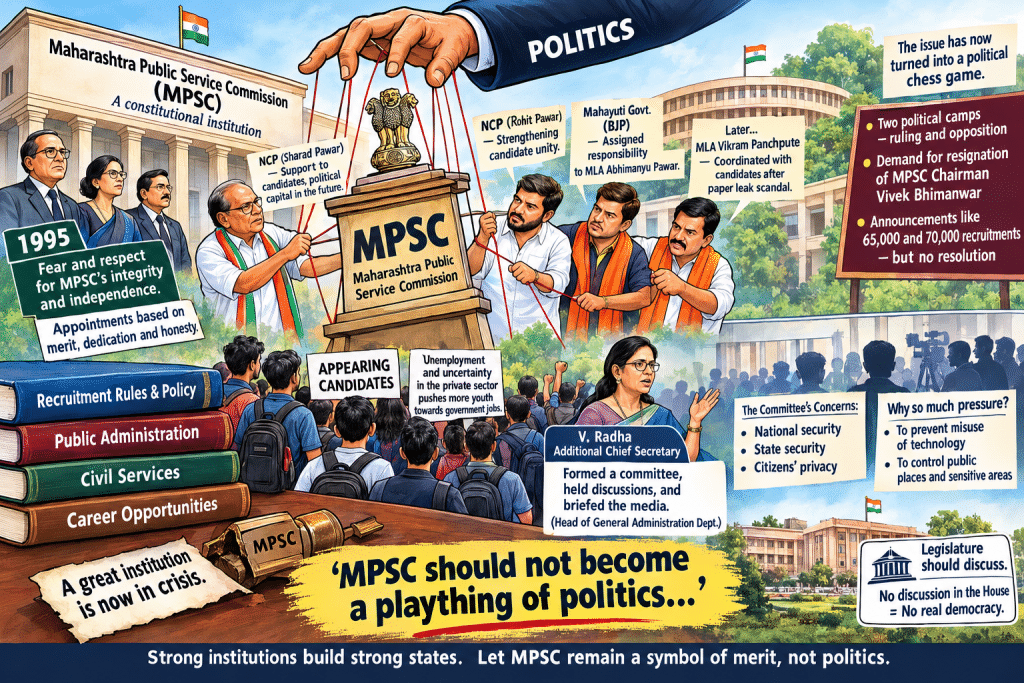
‘MPSC’ Should Not Become a Political Toy
The Maharashtra Public Service Commission (MPSC), a constitutional institution, once commanded such respect that, until 1995, hardly anyone questioned its functioning. Political winds could never penetrate the institution’s steel framework. Care was taken to appoint its chairpersons and members on the basis of professional rigor, integrity and commitment to duty. However, its illustrious history began to suffer when the Shiv Sena-BJP government decided to appoint Shashikant Karnik as its chairman. The ongoing agitation in Pune now makes it evident that the institution has been caught in a political crossfire.
Before the agitation began in Pune, the BJP-led Mahayuti government made several attempts to defuse it. The Nationalist Congress Party–Sharadchandra Pawar has consistently expressed sympathy with candidates distressed by the functioning of the MPSC. While supporting their demands, there is little doubt that the party may also have calculated that, if the issue escalated, it could yield political dividends. When it became apparent that MLA Rohit Pawar was consolidating the candidates’ unity, the Mahayuti government, particularly the Bharatiya Janata Party, entrusted its MLA Abhimanyu Pawar with the responsibility of addressing the issue. He facilitated meetings between the candidates and Chief Minister Devendra Fadnavis on the issues they had raised. But after the question paper for the Drug Inspector examination was leaked and allegations emerged that a family member of someone close to him had benefited from it, the BJP assigned MLA Vikram Pachpute the responsibility of coordinating with the candidates.
Appointment of Radha committee
Pachpute took the aspiring candidates to Chief Minister Devendra Fadnavis and attempted to find a solution. All of this turned into a political contest to lead the agitation of MPSC candidates. Nobody could prevent the issue from becoming politicized. To defuse the candidates’ agitation, a committee headed by Additional Chief Secretary V. Radha was appointed. The committee invited MPSC aspirants to present their side, held discussions with them and heard their suggestions. Normally, heads of government committees avoid speaking to the media. V. Radha, however, briefed journalists after the committee meetings about the proceedings and the discussions that had taken place.
Interestingly, V. Radha herself handles the services portfolio in the General Administration Department (GAD) at Mantralaya. Her responsibilities cover a wide range of policy matters, from the All-India Services, including the IAS, to the recruitment of state government employees, service-entry rules, promotions and retirement. MPSC-related matters also fall within her purview. Had she been given the freedom to closely monitor the functioning of the institution and resolve important issues even before the special committee was appointed, she might well have been able to produce results. Even after her committee was constituted, however, the candidates’ agitation has not subsided.
Once two camps emerged, one backed by the ruling party and the other enjoying the sympathy of opposition parties, the issue escalated as expected. The protesters refused to accept any compromise unless MPSC Chairman Vivek Bhimanwar resigned. Even announcements of recruitment to 65,000 and 70,000 posts have failed to persuade them to withdraw the agitation. This clearly indicates that the candidates have lost faith in the MPSC. The current scenario is particularly distressing for an institution that was once held in high regard.
Maharashtra known as the best administered state
Maharashtra has long been recognized across the country for the quality of its administration. The MPSC was one of its principal pillars. For the state administration to function effectively, the people selected to serve in it must also meet high standards. Compared with other states, Maharashtra’s administration maintained a relatively good reputation. One reason was the sensitivity shown by political leaders in observing certain institutional norms.
Of course, not every government official is exemplary. Some are adept at staying close to politicians, providing the kind of service that pleases them, securing prestigious postings and becoming equally skilled at getting themselves transferred back to coveted positions. Despite this, the state administration as a whole remained within a certain institutional framework. Some credit for this must go to both the government and the MPSC. But it is increasingly evident that those days have changed drastically.
At the same time, the growing number of people dependent on government employment opportunities is an issue that deserves serious consideration. There has been little open discussion about why an increasing number of young people aspire primarily to government jobs. Economic liberalization, globalization and the resulting foreign investment should have created more and more employment opportunities in the private sector. Maharashtra has a reputation for being one of the leading states in the country in attracting both domestic and foreign investment. Why, then, have sufficient employment opportunities not been created?
We regularly hear reports about the huge investment agreements signed by Maharashtra under initiatives such as Make in India, Make in Maharashtra and at the World Economic Forum in Davos. But hardly anyone asks how many jobs have actually been created through these investments. The prominent opposition parties appear reluctant to raise such issues, perhaps sensing the political trouble they could invite.
White or saffron paper still awaited
Some time ago, Industries Minister Uday Samant said that a “saffron paper”, the Mahayuti’s term for what is traditionally called a “white paper”, would be issued on investment. Considerable time has passed since then, but the opposition has not even reminded the government of that promise. If all these issues were openly debated, it would send a clear message to the people of Maharashtra. But no such serious effort appears to be taking place. The growing frustration among young people is pushing them towards agitation, and that is the irony of the situation.
Uncertainty in private-sector employment is increasing the pressure on the MPSC. At the same time, the government’s financial position does not permit large-scale recruitment. Raj Thackeray recently said in Pune that, irrespective of which government comes to power, 70,000 posts will not be filled. There is some substance to this argument, and the government has not denied it either.
The agitation in Pune has intensified the political temperature. Verbal exchanges between Rohit Pawar and Vikram Pachpute have been visible. In reality, however, the legislature is the most effective forum in a democratic system. True democracy means that citizens should be able to resolve their problems through their elected representatives rather than being forced to take to the streets. Yet, while there is considerable talk of resolving many issues through street protests, the absence of a willingness to debate them on the floor of the legislature is deeply concerning.
No debate or discussion in Legislature
The MPSC’s annual report is tabled in the legislature, which means that it is placed before the public. Although news reports based on such reports are scarce, there is nothing to prevent legislators from demanding a discussion on them. Those MLAs who are speaking publicly about the MPSC should demand a discussion on the issue in the legislature. There may be an established convention that the functioning of a constitutional institution should not be debated directly. But why should the MPSC’s annual report not be discussed in the legislature? Government recruitment should not be considered an issue unworthy of discussion in the House.
Today, the number of government and semi-government employees exceeds 10 lakh. More than Rs 2 lakh crore is spent on their salaries, allowances and pensions. Yet there is hardly any discussion on such issues. Socialist leader Dr Ram Manohar Lohia once said, “When the streets fall silent, Parliament becomes wayward.” If the streets are now becoming crowded with agitations, how can Parliament or the state legislature remain silent?
The larger question, therefore, is not merely about an agitation or a recruitment process. It is about preserving the credibility and independence of a constitutional institution that has played a crucial role in shaping Maharashtra’s administrative system. The MPSC must remain an institution of merit and public trust- not become a political toy.