
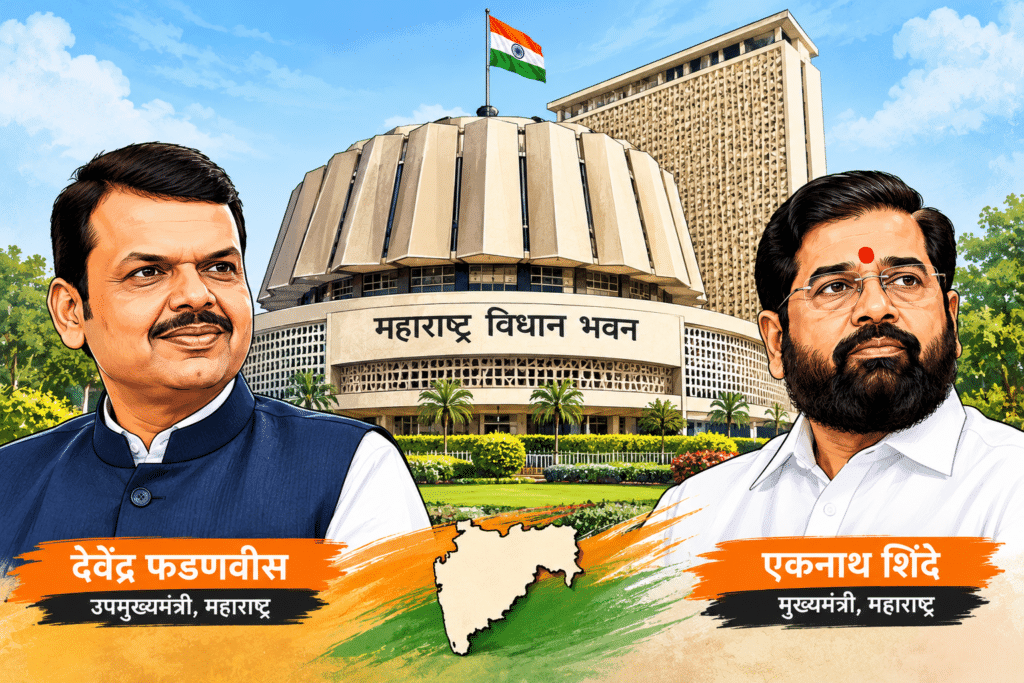
Mahayuti Alliance: Was the Satara Score Settled in Nagpur?
The results of the five Maharashtra Legislative Council seats have come as a rude shock to the Mahayuti alliance. The BJP and the Shiv Sena managed to win just two seats—the Pune Teachers’ and Amravati Teachers’ constituencies, respectively. Meanwhile, the Sharad Pawar-led Nationalist Congress Party (NCP-SP) and the Congress won the three graduate constituencies of Pune, Chhatrapati Sambhajinagar and Nagpur. The reactions from within the BJP suggest that the defeats in Pune and Nagpur have particularly stung the party.
Had the Shiv Sena honoured the spirit of the Mahayuti alliance and coordinated with the BJP and the NCP, the alliance might have won all five seats. Instead, in its bid to secure a seat in Pune, the Shiv Sena put its allies in an awkward position and potentially cost the alliance victories in three constituencies. The state BJP’s response—that undermining alliance partners to secure an individual victory was not in the Mahayuti’s interest—made it evident that the rift within the ruling alliance had widened. Differences that had hitherto been discussed discreetly have now surfaced with greater intensity.
For the past few months, there had been quiet speculation that Deputy Chief Minister Eknath Shinde was unhappy with the state leadership. He had skipped several important meetings convened by Chief Minister Devendra Fadnavis in recent months. Instead, he appeared more inclined to meet the BJP’s central leadership in Delhi, particularly Prime Minister Narendra Modi and Union Home Minister Amit Shah. There had also been talk in Mantralaya corridors of differences between BJP and Shiv Sena ministers over various issues. The Legislative Council elections appear to have brought these underlying tensions to a head.
Shinde had sought the Pune Teachers’ constituency seat. When his demand was not accepted, he backed independent candidate Sachin Sanap, creating considerable difficulties for the BJP.
In the Chhatrapati Sambhajinagar Graduate constituency, former minister Abdul Sattar, a member of Shinde’s Shiv Sena, openly campaigned against Satish Chavan, the Mahayuti candidate. In Nagpur, the Shiv Sena allegedly kept its distance from the campaign of BJP candidate Sudhakar Kohale. These developments further angered the BJP.
The origins of the BJP–Shiv Sena rift may lie in the Satara Zilla Parishad elections. Shinde’s Shiv Sena and Sharad Pawar’s NCP had joined hands there in an attempt to gain power. The BJP, however, thwarted their move, allegedly using police force. The Shiv Sena is said to have remained resentful ever since. It is therefore worth asking whether the Legislative Council elections offered the party an opportunity to settle scores.
The Legislative Council’s Intriguing Political Equations
In politics, appearances can be deceptive. Leaders who pose for photographs radiating camaraderie may be rivals behind the scenes, while those who appear to be adversaries may quietly work towards common objectives. Candidates change from one election to another, and parties adapt their strategies accordingly. The intriguing equations that emerged from the recently concluded Legislative Council elections lend credence to such suspicions.
Sharad Lad, son of sitting Pune Graduate constituency member Arun Lad, unexpectedly joined the BJP. There was speculation that he had been promised a nomination. Eventually, however, his candidature was dropped and Smita Yogesh Jadhav was nominated instead.
Smita is the niece of Congress leader Satej, popularly known as Bunty, Patil, and the wife of Yogesh Jadhav, owner of the Kolhapur-based daily *Pudhari*. A social media post by Ravindra Dhangekar of Shinde’s Shiv Sena concerning her nomination appears to have complicated matters for the Mahayuti candidate. The Sharad Pawar faction of the NCP fielded Harshada Deshmukh against Smita Jadhav and mounted a systematic campaign.
The Pune Teachers’ constituency, too, produced a surprise. Congress candidate Jayant Asgaonkar was widely considered the frontrunner, yet the relatively inexperienced BJP candidate Kaustubh Gawade emerged victorious.
Gawade, chief executive officer of the Vivekanand Education Society in Kolhapur, may not have been familiar to educational institutions across western Maharashtra. Nevertheless, the results suggest that institutions in Pune, Satara, Sangli and Solapur districts helped him secure victory. Many of these institutions were believed to be under the influence of prominent Congress and NCP leaders. Should Gawade’s victory over Asgaonkar be dismissed as a mere coincidence?
Marathwada, Too, Throws Up Puzzling Equations
The possibility of behind-the-scenes understandings in the Pune Teachers’ and Graduate constituencies becomes even more intriguing when the results in Marathwada are examined.
Satish Chavan, a three-time winner, found himself in a difficult contest and was defeated by Pratapsinh Patil, who had attracted relatively little attention before the election. The outcome was significant.
Pratapsinh, who contested on behalf of the NCP-SP, is the brother of Dr Rahul Patil, a Parbhani MLA belonging to the Shiv Sena (Uddhav Balasaheb Thackeray). Rahul Patil is regarded as a trusted associate of Uddhav Thackeray. Against this backdrop, it is puzzling that Thackeray’s party fielded a separate candidate.
Popular social media influencer Raviraj Sable Patil also secured a substantial number of votes. BJP leaders in Dharashiv, where Pratapsinh Patil resides, as well as elsewhere in the district, appeared favourably disposed towards his victory. Former minister Abdul Sattar also played a role in the contest.
These developments cannot be viewed simply as isolated incidents. They raise questions about whether political calculations and informal understandings influenced the outcome.
An Unexpected Challenge from a Rebel in Nagpur
The Nagpur Graduate constituency has traditionally been a BJP stronghold. Prominent BJP leaders, including the late Gangadharrao Fadnavis, Nitin Gadkari and Anil Sole, have represented the constituency. Yet, in 2020, the Congress wrested the seat from the BJP after a gap of 58 years. Congress candidate Abhijit Vanjari defeated Sandeep Joshi, the BJP’s then mayor of Nagpur, in what was widely regarded as a historic victory.
At the time, the contest was interpreted through the prism of caste politics, particularly the equation between Other Backward Classes (OBCs) and Brahmins. Developments within the Nagpur Municipal Corporation added another dimension to the political backdrop. The confrontation between then municipal commissioner Tukaram Mundhe and Mayor Sandeep Joshi had attracted considerable attention.
The Maha Vikas Aghadi government, led by Uddhav Thackeray, had appointed Mundhe as municipal commissioner. His attempts to enforce greater discipline in the corporation’s administration triggered a bitter confrontation with Joshi and other BJP councillors.
The repercussions of this confrontation were widely believed to have influenced the Graduate constituency election and contributed to the BJP’s defeat. Subsequently, the BJP denied a nomination to Anil Sole, who belonged to the Brahmin community, and chose Sudhakar Kohale, an OBC leader, instead. Consequently, this year’s contest featured two OBC candidates.
Another drama unfolded around Nitesh Karale, who was associated with the NCP-SP. He entered the electoral fray without the party’s approval. Considered a potential threat to the prospects of Abhijit Vanjari, the Maha Vikas Aghadi candidate, Karale was expelled from the party before polling.
Karale subsequently posted a video on social media in which he was seen breaking down while explaining his side of the story. He went on to secure more than 24,000 votes. Although Vanjari ultimately won, Karale’s tally was substantial enough to merit attention.
Moreover, 15,032 votes in the constituency were declared invalid. Some voters had failed to mark their first preference and had recorded only their second preference. This unusual pattern raises questions about voter awareness, the conduct of the election and the circumstances surrounding the invalid ballots.
Karale’s expulsion was intended to prevent him from disrupting the electoral arithmetic in the Maha Vikas Aghadi’s favour. But how should one interpret the fact that candidates associated with constituent parties of the same alliance rebelled in neighbouring Amravati, Marathwada and Pune divisions? The Shiv Sena (UBT) had even publicly indicated that its support could not be taken for granted. These developments raise serious questions about coordination and cohesion within the opposition alliance as well.
Confusion Within the Alliance in Amravati
The Amravati Teachers’ constituency presented another example of conflicting political strategies. The Congress nominated Aditi Pohare, while her opponent was sitting MLA Kiran Sarnaik of Eknath Shinde’s Shiv Sena, who had joined the party only recently. Initially, the contest appeared relatively straightforward. However, Dattatray Lahane of Uddhav Thackeray’s Shiv Sena also entered the fray.
It is difficult to rule out the possibility that this decision confused supporters and voters of the Maha Vikas Aghadi. While one constituent of the alliance was working to secure victory for its candidate, another fielded a candidate of its own. Was this merely a disagreement over candidate selection, or did it reflect a deeper lack of coordination? The political implications merit scrutiny.
Were Invisible Forces at Work?
Taken together, developments across all five constituencies suggest that the elections involved more than straightforward contests between rival parties. Behind-the-scenes calculations, competing ambitions and possible informal understandings appear to have shaped the political landscape. For party workers who campaign sincerely for their respective organisations, such contradictory manoeuvres can be bewildering.
The conflicting strategies adopted by different parties and their leaders suggest that considerable political activity was taking place away from public view. Once again, the Legislative Council elections have demonstrated how sharply the political equations visible to voters can differ from the calculations that may actually determine electoral outcomes.
For the Mahayuti, the results have exposed serious differences between its principal constituents, particularly the BJP and Shinde’s Shiv Sena. For the Maha Vikas Aghadi, the victories have demonstrated that it can capitalise on divisions within the ruling alliance, even as its own coordination problems remain evident.
The central question, therefore, is whether the Legislative Council results mark a temporary setback for the Mahayuti or signal a deeper fracture within the alliance. Was the political score from Satara settled through the contests in Nagpur and elsewhere, or were these outcomes the product of a more complex web of local rivalries and electoral calculations?
The answers may emerge in the political battles ahead. For now, one thing is clear: the fault lines within Maharashtra’s ruling alliance have become harder to conceal, and their consequences could extend well beyond the Legislative Council elections.