Why So Much Unease Within the Mahayuti?
Despite enjoying a comfortable majority, the Mahayuti government appears to be lacking the confidence and political momentum expected of a ruling alliance. Internal challenges facing all three constituents seem to be taking a toll on the government’s functioning.
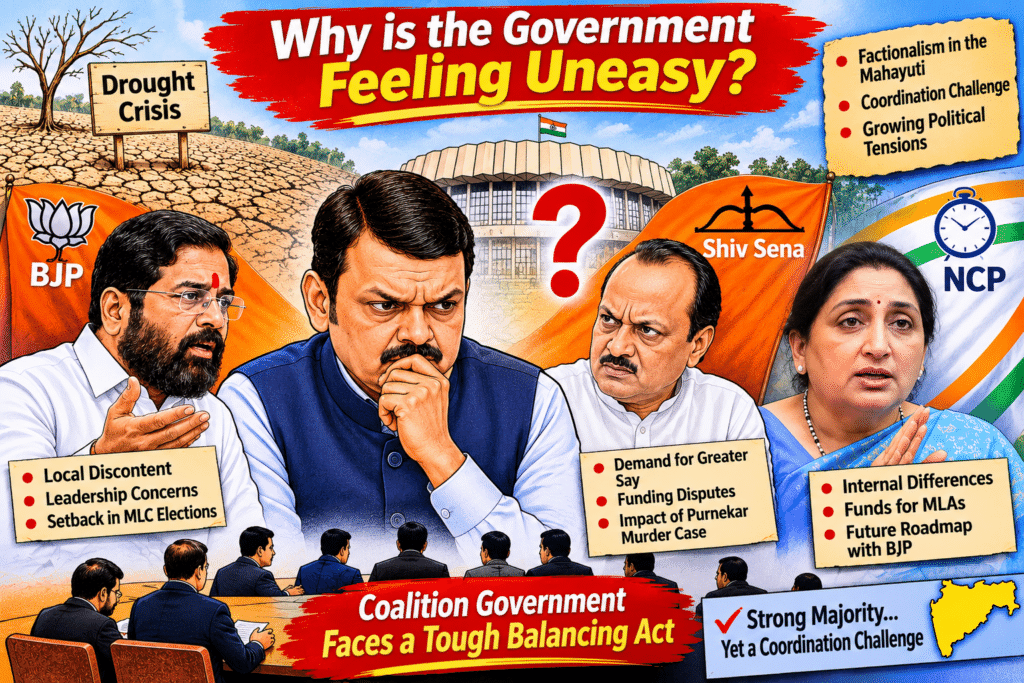
The Mahayuti government, led by Chief Minister Devendra Fadnavis, will complete two years in office next month. Despite enjoying a comfortable majority in the Legislative Assembly, the government does not appear to be basking in confidence or enthusiasm. The drought crisis facing the state does not seem to be the sole reason for this apparent lack of momentum. Rather, the picture suggests that the government’s overall functioning could be affected by the internal challenges confronting all three constituents of the ruling alliance.
The drought situation is undoubtedly a matter of serious concern. However, a government backed by such a substantial majority is expected to respond to challenges with greater determination. The BJP, Eknath Shinde’s Shiv Sena and Sunetra Pawar’s NCP are, however, grappling with different political and organisational problems. The cumulative impact of these developments could have implications for the stability and efficiency of the government.
Efforts are underway to maintain coordination among the alliance partners over the distribution of power, allocation of funds and their respective roles in political decision-making. Yet, mutual distrust, local-level conflicts and the struggle for political supremacy are becoming increasingly evident. Differences within the Mahayuti surfaced during the municipal corporation and Zilla Parishad elections held towards the end of last year and early this year. They have become even more apparent in the recent elections to five Legislative Council seats.
The Current Mood Within the BJP
As the strongest constituent of the Mahayuti, with its leader occupying the Chief Minister’s post, the BJP exercises considerable influence over the government’s decision-making machinery. However, while retaining its political dominance, the party must also ensure that its alliance partners receive adequate representation and political space.
Within the BJP itself, resentment among local leaders over nominations, distribution of positions and their standing within the organisation is becoming increasingly visible. The discontent witnessed during the Nagpur Graduates’ constituency election to the Legislative Council was one such manifestation.
The situation has been further complicated by important organisational appointments within the state BJP. For the first time, the central leadership has entrusted the key post of State Organisation Secretary to a leader from outside Maharashtra. If some state leaders perceive that the appointee will enjoy closer proximity to the central leadership, it is understandable that this could create unease within the state unit.
Adding to the party’s concerns, the BJP recently failed to win the Legislative Council elections in the Nagpur and Pune Graduates’ constituencies. The central leadership is understood to have taken serious note of these defeats, and a committee is reportedly examining the reasons behind them.
An audio clip recently released by Maratha reservation activist Manoj Jarange Patil has also triggered considerable political controversy. Conversations allegedly involving certain individuals associated with BJP circles have raised several questions and generated widespread public debate. The episode appears to have placed the BJP in an uncomfortable political position. Against this backdrop, the Shiv Sena has also raised certain demands, adding another dimension to the internal dynamics of the Mahayuti.
Shiv Sena Also Grappling with Tensions
For Eknath Shinde, remaining in the government is only one aspect of his political priorities. Preserving his independent political identity, strengthening the Shiv Sena organisation and accommodating the aspirations of party workers are equally important. Within the party, there is a growing perception that the Shiv Sena is not receiving the importance it expects in government decision-making, particularly in comparison with the BJP.
Differences are reportedly emerging over ministerial positions, appointments to statutory corporations, allocation of funds and the distribution of political power at the local level.
During the recent Legislative Council elections, the Shiv Sena was keen to secure the Pune Teachers’ constituency. However, after conceding the seat, the party extended its support to Sachin Sanap. The decision triggered strong reactions within the BJP. Although the BJP candidate eventually won, the Shiv Sena’s displeasure was difficult to conceal.
The BJP’s inability to win the Pune and Nagpur Graduates’ constituencies was partly attributed to the Shiv Sena’s lack of cooperation. There were also suggestions that this non-cooperation had affected the NCP. In the Chhatrapati Sambhajinagar Graduates’ constituency, NCP candidate Satish Chavan suffered defeat. These elections exposed the limitations of coordination within the Mahayuti and further deepened mutual distrust among its constituents.
The Purnekar murder case in Thane has also pushed the Shiv Sena into a defensive position. Since Thane is Eknath Shinde’s political stronghold, the party could face political repercussions arising from the case. Shiv Sena leader Meenakshi Shinde and her husband have come under scrutiny over allegations of their involvement in the murder. The political atmosphere in Thane has consequently become tense. While the investigation must establish the facts, the political fallout could become a matter of concern for the party.
The audio clips released by Manoj Jarange Patil have provided the Shiv Sena with another opportunity to adopt an aggressive political posture. An alleged reference in the conversation to Deputy Chief Minister Eknath Shinde’s son, Shrikant Shinde, having arranged for Rs 500 crore to be delivered to Jarange Patil stirred considerable controversy.
Although the issue has somewhat receded from the spotlight following the appointment of a Special Investigation Team to probe the matter, the Shiv Sena has used the controversy to question the BJP. This is particularly significant because the audio clips are also said to contain references to conversations involving individuals associated with the BJP.
Major Challenges Before the Nationalist Congress Party
Following the death of Ajit Pawar, efforts are underway to rebuild the NCP under Sunetra Pawar’s leadership. However, maintaining internal coordination has emerged as a major challenge. Ensuring harmony among Sunetra Pawar, Parth Pawar, Jay Pawar, Praful Patel, Sunil Tatkare and other senior leaders is essential. Reconciling the expectations of established leaders, the decision-making approach of the new leadership and the competing interests of different factions will be critical to the party’s future.
Meanwhile, complaints are growing among NCP legislators that they are not receiving adequate funds for constituency development compared with their counterparts in the BJP and Shiv Sena. The NCP’s core committee has met twice within three days. Separate meetings of senior leaders and reports of internal differences have further fuelled political speculation.
Reports suggest that NCP legislators have expressed dissatisfaction over fund allocation and delays by ministers from alliance partners in approving development proposals. At a meeting of NCP legislators held on Tuesday night, complaints were reportedly raised about the lack of necessary cooperation from Shiv Sena ministers.
This is particularly interesting in the context of the events of 2022. When Eknath Shinde and his colleagues deserted Uddhav Thackeray, one of their principal complaints was that the then Deputy Chief Minister, Ajit Pawar, was neither releasing adequate funds nor extending sufficient cooperation for development works. If Shinde’s colleagues are now facing similar allegations from NCP legislators, it reflects a significant shift in the political equations.
The larger question is whether this is merely a dispute over the allocation of funds or whether it reflects a perception within the Shiv Sena that the NCP’s participation in the government has weakened its own bargaining power.
Sunetra Pawar’s NCP would also be closely watching the evolving relationship between Sharad Pawar’s faction and the BJP, as well as the possibility of any political realignment. A remark made by Prime Minister Narendra Modi on Wednesday, while enquiring about Sharad Pawar’s health, has triggered fresh speculation in political circles.
Modi reportedly said, “We, along with Supriya Sule, will look after the country; you give us your blessings.” The political significance of this remark has become a subject of discussion, particularly over the context in which the Prime Minister referred to managing the country together with Supriya Sule.
Questions have once again surfaced over whether the Nationalist Congress Party (Sharadchandra Pawar) could become a constituent of the National Democratic Alliance (NDA), or whether the two NCP factions might eventually merge. Speculation about the BJP’s interest in leveraging Sharad Pawar’s political influence and legacy in Maharashtra is not new. The latest developments have once again brought this possibility into focus.
The Challenge of Coordination Despite a Majority
The stability of a coalition government depends on much more than its numerical strength in the Legislative Assembly. Mutual trust among alliance partners, an equitable distribution of power and effective coordination in governance are equally important. Although the Mahayuti enjoys a comfortable majority, the internal problems and competing political interests of its three constituents could affect the government’s overall functioning.
Chief Minister Devendra Fadnavis, therefore, faces a dual challenge. While retaining the BJP’s leadership position and its influence over government decision-making, he must ensure that Eknath Shinde’s Shiv Sena and Sunetra Pawar’s NCP receive their due share of power and adequate political space.
At the same time, the government cannot afford to lose sight of its responsibilities towards the people. Its response to the drought situation, development-related concerns and other pressing challenges facing Maharashtra must remain effective.
A comfortable majority may provide numerical strength, but it cannot automatically guarantee political stability or administrative efficiency. For the Mahayuti, the real test lies in reconciling the competing ambitions of its constituents, restoring mutual trust and demonstrating collective responsibility in governance.