The NCP in Tatters, and the BJP Holds the Cards
Recall the days following the formation of the Nationalist Congress Party (NCP). Within six months of its birth, the Sharad Pawar-led party forged an alliance with the Congress, despite being a breakaway outfit comprising former Congress leaders. The Congress-led alliance went on to rule Maharashtra for 15 years. That sequence tells us something about the political clout Sharad Pawar once commanded. Those were different times.
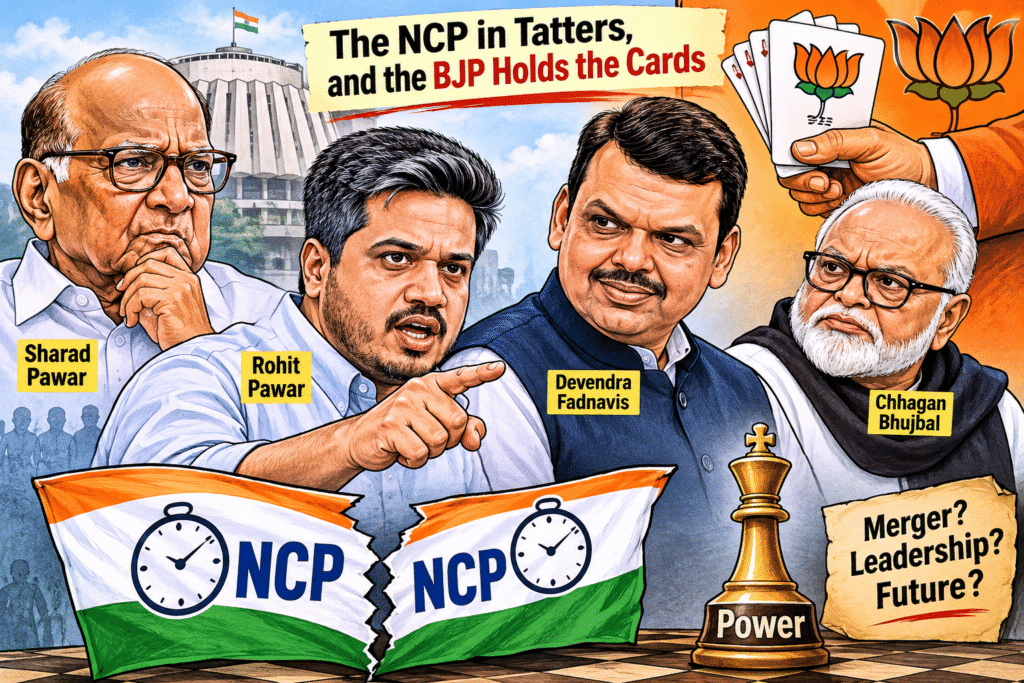
Today, the party is split in two, with both factions struggling to hold their ground in Maharashtra politics. Ever since Deputy Chief Minister Ajit Pawar died in a plane crash, talk of a merger between the two parties—or, more accurately, the two factions—has repeatedly resurfaced in the state’s political discourse. At times, it has appeared to be a one-sided exercise. On more than one occasion, Ajit Pawar’s colleagues distanced themselves from any discussion of a possible merger. Dada, they insisted, had never discussed such a plan with the Sharad Pawar-led faction. That was the position they publicly maintained.
The Game of a Possible Merger
When merger talk suddenly resurfaced before Diwali, it appeared as though some leaders on either side had been swept up in a filmi rush of sentiment. “Bhaiyya, yeh deewar kyun nahin toot ti?” (Brother, why won’t this wall come down?) But it soon became apparent that the episode was unfolding against the backdrop of the NDA’s efforts to muster numbers for its ambitious Delimitation Bill and a constitutional amendment proposing to increase the strength of the Lok Sabha to 850. The entire NCP episode began to resemble a scene from _Sangeet Bhavbandhan_, the old Marathi musical about emotional ties, with the BJP directing the show.
The subject resurfaced in the first week of November. On November 1, Praful Patel, Sunil Tatkare, Chhagan Bhujbal, Hasan Mushrif, Dilip Walse-Patil and Dhananjay Munde met Union Home Minister Amit Shah in Delhi. The leaders concerned denied that the merger had figured in their discussions. On November 5, Praful Patel called on Sharad Pawar at Breach Candy Hospital. A reference during the visit to sitting down for talks after November 10 set political circles buzzing. Around the same time, Parth Pawar visited Sharad Pawar at his Breach Candy residence on two successive days. These visits were described as personal.
Leaders from Sharad Pawar’s camp, including Jayant Patil, Shashikant Shinde, Amol Kolhe, Anil Deshmukh and Jitendra Awhad, also called on him. Whether any of these meetings had a direct bearing on the proposed merger remains unclear. They certainly gave the speculation fresh momentum.
Sunil Tatkare’s statement stood out amid this flurry of developments. He said that, had Ajit Pawar been alive, the merger would have taken place on February 12. Minister Chhagan Bhujbal maintained that discussions were still at a preliminary stage. MP Supriya Sule, meanwhile, said the process had stalled after Ajit Pawar’s death and that no formal proposal had been placed before Sharad Pawar.
Rohit Pawar Turns the Tables
The seemingly choreographed meetings of senior leaders, the contradictory statements that followed and the speculation they generated have kept the merger debate alive. How much actual ground has been covered remains anybody’s guess. Bringing the two factions together is only one part of the exercise. Who will lead the reunited party? What role will it play in government? The answers are far from straightforward.
Amid all this clamour, Rohit Pawar, a young member of the Pawar family, appears to have turned the tables. A photograph he made public has caused unease in both NCP camps. Senior leaders on either side are unhappy that he has chosen to target Chief Minister Devendra Fadnavis. Their predicament is that party workers may now begin to suspect that the Chief Minister’s alleged links with the owner of the aviation company that operated the ill-fated plane are somehow connected to the delay in the inquiry into the crash that killed Ajitdada.
In such circumstances, senior party leaders may think twice before proceeding with a merger. Even if they do, they will have to consider the message such a move would send.
Barring a few statements by state Congress president Harshwardhan Sapkal, few political leaders have lately shown the temerity to take on Chief Minister Devendra Fadnavis personally. Rohit Pawar has done precisely that. He could emerge from this episode either a hero or a zero. Few would believe that he took such a bold step without consulting someone in the family or the party.
The NCP’s predicament, however, goes much deeper.
The urge to remain in power has hollowed out the NCP. Much of its present crisis can be traced to its instinct to stay close to power and its failure to decide what kind of relationship it wanted with the BJP. If the NCP was cultivating cordial ties with the BJP even before 2014, discussing the possibility of joining hands, contesting elections together and sharing power while still being part of the Congress-led government, it takes no political pundit to figure out how the Congress must view the party today.
The NCP may have calculated that if it wanted to teach the Congress a lesson, it would be better off with the BJP on its side. There was also a broader political calculation behind its swift and unsolicited offer of support to the BJP government in 2014, to deprive the Shiv Sena of its bargaining power.
The BJP, for its part, had already given some thought to cutting the Sena down to size. That is why it announced its plan to go solo just before the 2014 elections. But the Shiv Sena, under Uddhav Thackeray, performed better than expected, winning more than 60 seats. The BJP had to swallow its pride and keep the Sena out of the government initially. It eventually brought the Sena into the government, passing up the NCP’s offer.
The gulf between the NCP and the Congress only widened. But NCP leaders found themselves in a fix, having rarely been out of the corridors of power.
Some NCP leaders were already trying to move closer to the BJP in the hope that inquiries and court cases against them would be dropped. But to abandon Sharad Pawar and cross over to the BJP, they needed Ajit Pawar to lead them. That was the condition laid down by the other side. The calculation was that the NCP’s consolidated vote bank could be broken only by splitting the party and dividing the Pawar family. It was a crucial subplot in Maharashtra’s political script.
The Confusion Within the Party Continues
In February 2024, the Election Commission recognised Ajit Pawar’s faction as the official NCP and allotted it the clock symbol. Everything appeared to be going according to plan. Yet some leaders remained keen on a merger. Just when the process seemed to be gathering momentum in early 2026, Ajit Pawar died in a plane crash. The merger exercise, about which few outside the inner circle knew much, came to a halt.
The second act is now under way, with considerable confusion in both camps. Some leaders oppose a merger. Others are worried about who will get which party post or ministerial berth. The question of political survival is clearly as important as the question of unity.
Chief Minister Devendra Fadnavis’s position is particularly telling. He has said that both NCP factions are free to decide their own future. At the same time, he has made it clear that a merger cannot happen without the BJP’s knowledge. The implication is unmistakable: the BJP expects to have a decisive say in determining the political course of a reunited NCP.
Were the January talks, then, taking place without the BJP’s knowledge? If so, was a united NCP prepared to risk remaining out of power? And had the other leaders agreed to such a possibility?
The real questions begin once the two factions come together. Who will lead the reunited NCP, and whom will it align with? The talks that began during Ajit Pawar’s lifetime have, in his absence, become a means of testing new equations of power. Even before a merger has been announced, calculations are already under way about who stands to gain and who stands to lose.
The NCP was once a party that could dictate the terms of Maharashtra’s politics. Today, it is struggling to decide its own future. In the 27th year since its formation, the question is no longer merely whether the two factions will reunite, but whether the party will retain an independent political identity at all.
———————————————–