
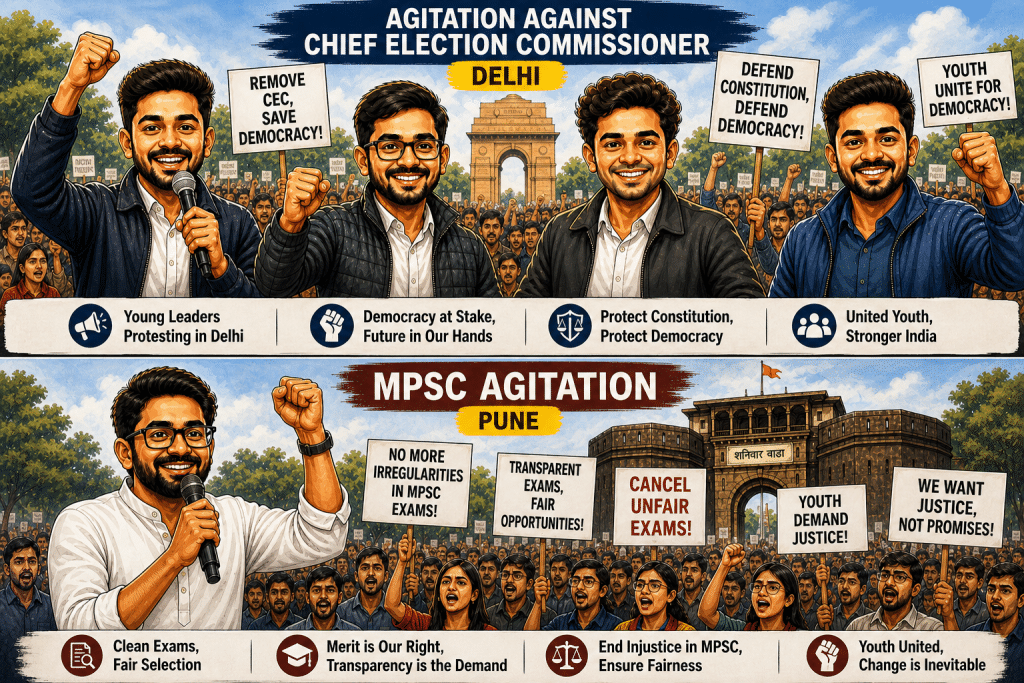
Rise of Dipke, Das, Ranka, Bora Challenges Conventional Political Definitions
Circumstances create leaders, while struggle gives them strength and credibility. Across India, many leaders have emerged from movements. Some championed the causes of farmers and agricultural labourers, others fought for workers and the oppressed, while still others brought the concerns of the salaried middle class into the public discourse.
In recent years, however, the political landscape has increasingly given the impression that movements must be weakened or contained to prevent new leadership from emerging. Meanwhile, the children and relatives of established politicians across almost every political party continue to occupy positions of influence, often by virtue of their family connections.
For ordinary people, challenging this entrenched leadership is rarely easy. Established political families control extensive networks of cooperative institutions, processing industries, banks and educational establishments built by their predecessors. Those who depend on these institutions for their livelihoods often find it difficult to challenge their authority. Instead, they learn to cultivate proximity with local political heavyweights, addressing them as Dada, Aba, Bhaiyya or Kaka in the hope of getting their work done.
When people stop coming forward to participate in movements, the emergence of leaders without established political backgrounds gradually declines. But circumstances wait for no one, and struggles never really end. They continue to create new leaders.
Leaders Without Political Baggage Emerge
Across the country, educational institutions run by politically influential individuals wield considerable power. Their financial resources and political networks often enable them to influence the system. Students, already frustrated by arbitrary practices in private educational institutions and the rising cost of education, reached the limits of their patience following allegations of paper leaks in competitive examinations and entrance tests.
The agitation that followed created space for a new generation of leaders, many of whom do not appear to come from established political families.
The satirical initiative known as the Cockroach Janata Party (CJP) brought young activists Abhijeet Dipke, Ashutosh Ranka, Saurav Das and Ajinkya Shinde into the limelight. The controversy surrounding the alleged leak of the NEET examination paper brought student discontent into the national spotlight and intensified political pressure on Union Education Minister Dharmendra Pradhan.
Whether a movement led by an established political party would have achieved a similar impact is debatable. Nevertheless, the protests demonstrated that organised student anger could compel the political establishment to respond.
Another emerging figure is Neha Bora, national president of the All-India Students’ Association (AISA). Her participation in student movements and protests over electoral issues has brought her into the public spotlight.
What Are Politicians With Strong Political Backing Doing?
Maharashtra has witnessed a similar phenomenon. Vivekanand Patil, a young man from an ordinary family, emerged as a prominent face during an agitation in Pune over alleged irregularities in the functioning of the Maharashtra Public Service Commission (MPSC). His role attracted attention across the state.
His emergence demonstrated that young people do not necessarily need a political legacy or the backing of powerful institutions to raise issues affecting students.
This raises an uncomfortable question: what are the Dadas, Kakas, Bhaiyyas and Abas with established political backgrounds doing while young people take to the streets?
There are exceptions. MLA Rohit Pawar, for instance, has consistently raised issues concerning MPSC aspirants over the past few years.
Questions are frequently raised about the role of the Opposition in Maharashtra. A few names stand out, including Maharashtra Pradesh Congress Committee president Harshwardhan Sapkal, party spokesperson Atul Londhe, Swabhimani Shetkari Sanghatana leader Raju Shetti, farmer leader Ravikant Tupkar from Buldhana, and former Chief Minister Prithviraj Chavan, who has also occasionally raised his voice on public issues.
Yet the Opposition’s collective and sustained engagement with broader public movements remains less visible than expected.
The agitation over the problems faced by tribal students has also gathered momentum. When the students indicated that they intended to stage a protest in Mumbai, they were put on a bus and sent to Nashik.
If the administrative response focuses on managing protests rather than addressing the grievances that trigger them, questions about governance are inevitable.
Highly Educated Young Leaders Take the Lead
The Cockroach Janata Party emerged this year as a platform claiming to represent students and young people. Its activities have brought together young people with experience in digital campaigning, journalism, public policy and student politics.
Abhijeet Dipke is regarded as the CJP’s founder, national convener and principal strategist. After graduating in journalism and mass communication in Pune, he reportedly pursued postgraduate studies in public relations at Boston University in the United States.
Ashutosh Ranka, the organisation’s co-convener, is involved in policy formulation and strategic planning. He is reported to have earned a BTech degree from IIT Kanpur and a postgraduate qualification in public administration from the London School of Economics. He has also reportedly worked as a consultant at McKinsey & Company.
Saurav Das, the organisation’s chief spokesperson, has a background in journalism. His work relating to legal affairs, the judiciary and social issues has contributed to his public profile. A journalism and mass communication graduate from Amity University, Das was also associated with anti-pollution protests in the India Gate area in November 2025.
Ajinkya Shinde, who has recently come into the spotlight, serves as the organisation’s national head of organisation and strategist. He is said to be involved in organisational development, planning and behind-the-scenes coordination. According to reports, the CJP entrusted him with greater responsibility after Delhi Police detained Dipke, Ranka and Das.
The educational backgrounds of these young leaders point to an important development. Higher education, modern communication skills and an understanding of public policy are not merely qualifications for careers in multinational companies. They can also be used to mobilise people and build movements around public issues.
Neha Bora’s Role Becomes a Talking Point
Neha Bora, national president of the All-India Students’ Association, has also attracted considerable attention. AISA has played an important role among the left-wing student organisations supporting the CJP’s agitation.
Bora graduated in sociology from Hindu College, University of Delhi, and pursued postgraduate studies at Dr Babasaheb Ambedkar University. She is currently pursuing doctoral research in theatre and performance studies at the School of Arts and Aesthetics at Jawaharlal Nehru University.
Following a protest at Jantar Mantar in July, her participation in subsequent demonstrations against the Special Intensive Revision of electoral rolls and in support of the demand for the Chief Election Commissioner’s resignation became a subject of public discussion.
These developments reflect the emergence of a form of political leadership that operates through student organisations and public campaigns rather than following the conventional routes of established politics.
While these young activists are taking up issues despite the potential consequences, what are the younger leaders within established political parties doing?
Vishwajeet Kadam was among those who extended support to the MPSC agitation in Pune. However, several political leaders backed by large educational establishments, cooperative institutions and extensive political networks appear content to watch such protests from the sidelines.
A Conspiracy of Silence to Protect Institutions?
Could concern about the future of their institutions explain this silence?
Many educational and other institutions controlled by politicians depend on government grants, permissions, land-related decisions and administrative approvals. Their leaders may fear that confronting the government could adversely affect the functioning or future of these institutions.
Some political leaders, particularly when dealing with the BJP-led National Democratic Alliance government, appear to be exercising considerable caution.
However, protecting institutional interests and raising public issues are not mutually exclusive responsibilities. On the contrary, those who manage institutions established with public support have an even greater obligation to remain accountable to society.
If institutions built with government grants, concessions, land allocations and administrative support are run as though they were the private property of a few individuals, their functioning deserves scrutiny. Silence on public issues is difficult to justify in the name of protecting institutional interests.
Congress leader Rahul Gandhi has been at the forefront of the confrontation with the Centre over the functioning of the Election Commission. The question is how many leaders from Maharashtra have joined the agitation in solidarity with him.
Overall, the participation of Maharashtra’s political leadership has not been particularly conspicuous. Some leaders may find it politically inconvenient to confront parties in power at the Centre and in the state.
But politics cannot always be conducted according to calculations of convenience. Student grievances, farmers’ problems, public protests and concerns about the electoral process are tests of political commitment. When the time comes to take a stand, leaders reveal where their priorities lie.
It is easy to claim credit for a movement after it succeeds. Standing alongside those who are struggling while the outcome remains uncertain is far more important.
Today, young people without established political backgrounds are challenging leaders who have risen on the strength of family legacies. How much public support these newcomers will secure, how long their leadership will endure, and whether they will retain their principles after becoming part of the establishment are questions only time can answer.
But the issues they have raised cannot be ignored.
The emergence of new faces in a political landscape dominated by Dadas, Abas, Bhaiyyas and Kakas is not merely a question of leadership change. It raises fundamental questions about political accountability, commitment to public causes and the growing challenge to dynastic politics.
No matter how powerful a political legacy or institutional network may be, a leadership vacuum inevitably emerges when those in positions of influence are unwilling to fight for public causes.
Perhaps it is this vacuum that young leaders such as Dipke, Das, Ranka and Bora are now stepping forward to fill.