
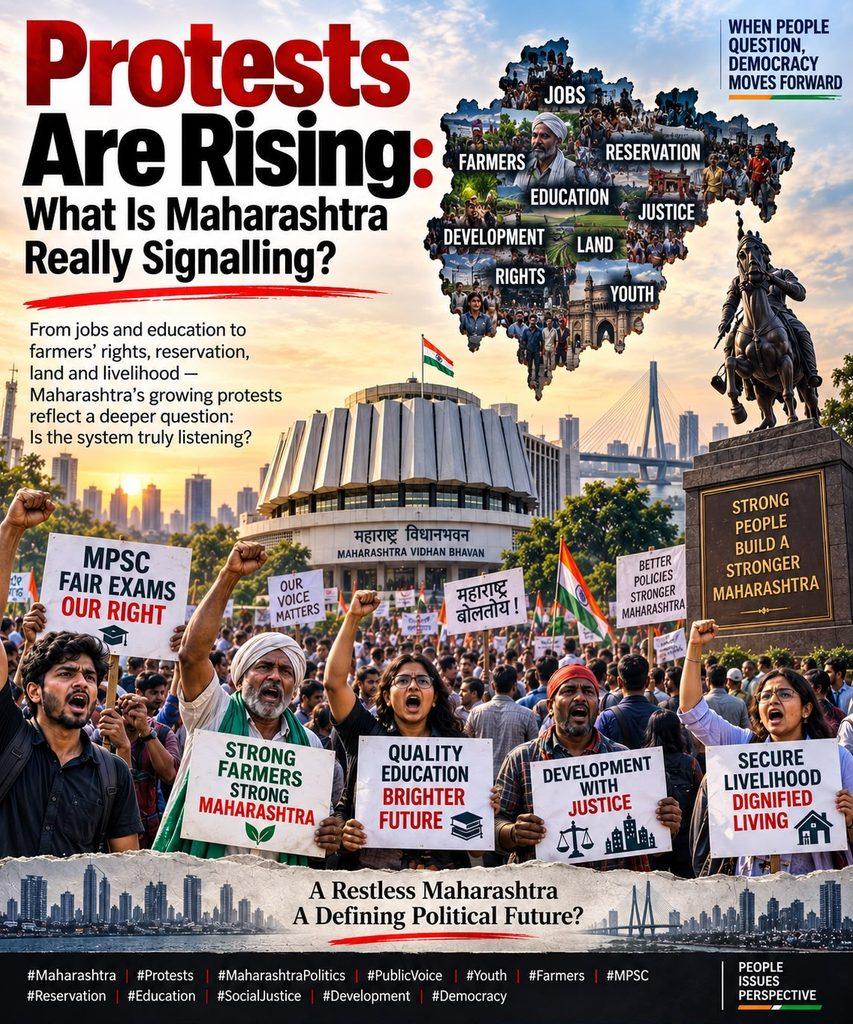
What Are the Rising Public Agitations Trying to Say?
Students, competitive examination aspirants, members of the Maratha and OBC communities, tribal students, farmers, government employees and urban citizens are currently taking to the streets over a range of issues in Maharashtra. While the immediate causes of these agitations are different, there is a common sentiment at their core: the government and administration are not listening to them seriously enough, and their problems do not get resolved unless they take to the streets.
This situation does not necessarily indicate an outright “anti-government wave” at present. But it certainly carries warning signals for those in power. A major political wave does not emerge overnight. When discontent over a series of small and large issues continues to accumulate, it can eventually acquire a common direction. The most prominent example of this process at present is the students’ agitation against the Maharashtra Public Service Commission (MPSC).
MPSC: A Crisis of Trust Beyond the Paper-Leak Issue
The alleged paper leak in the examination for the post of Drug Inspector has triggered a major outburst of anger among competitive examination aspirants across the state. Following the exposure of irregularities in the examination process, the examination was cancelled and investigating agencies have begun an inquiry.
With some individuals arrested in connection with the case, students are no longer demanding action merely against those responsible. They have begun questioning the credibility of the entire examination system.
On September 7, thousands of aspirants participated in an Aakrosh Morcha from Omkareshwar Temple to the District Collector’s office in Pune. Protests were also held in Amravati, Kolhapur and other major cities across the state. The issue, therefore, is no longer confined to Pune.
The students’ demands include the resignation of Maharashtra Public Service Commission chairman Vivek Bhimanwar and the joint secretary; a forensic audit of examinations conducted during the tenure of officials under suspicion; making the investigation report public; probing suspicious results; examining shortcomings in the evaluation process; and ensuring complete transparency in forthcoming examinations.
The government has appointed a high-level committee to review the security and transparency of recruitment examinations. But the students’ position is clear: they do not want assurances; they want concrete decisions.
This is where the MPSC agitation assumes wider significance. It is no longer merely a question of a paper leak in one examination. It has become a question of the value attached to the years of hard work put in by young people preparing for government jobs, transparency in the recruitment process and public trust in government institutions.
Reservation: One Decision, Two Sources of Discontent?
The Maratha reservation issue remains one of the most sensitive questions in Maharashtra politics. Under the leadership of Manoj Jarange-Patil, the Maratha community continues to agitate for eligible members to be issued Kunbi certificates so that they can avail themselves of reservation benefits under the OBC category.
Although the government has announced various measures and facilities, protesters have made it clear that the agitation will continue until their demands are met.
At the same time, unease is growing among OBC organisations. They have been demanding protection of the existing 27 per cent OBC reservation, opposing the blanket inclusion of the Maratha community in the OBC category, and calling for a caste census.
Thus, the reservation issue is no longer confined to the demands of one community. It is now intertwined with education, government employment, social representation and rural politics.
The challenge before the government is therefore enormous: while providing relief to one section, it must ensure that another does not develop a sense of injustice.
From Tribal Students to Agricultural Employees
In Nashik, tribal students staged a protest over poor-quality food in government hostels, inadequate facilities and administrative issues related to education. The fast was suspended following administrative intervention, but the protesters have warned of a long march towards Mumbai if their demands are not fulfilled.
The scale of this agitation may not match that of the MPSC or Maratha movements, but it raises an important question: How effectively and with what quality are the government’s welfare schemes actually reaching their intended beneficiaries?
Meanwhile, employees of the Agriculture Department are opposing the proposed new staffing structure. They argue that manpower will fall short in view of the growing number of farmers, the increasing workload on the department and the need for agricultural extension services. They have warned of an indefinite strike from September 21 if their demands are not accepted.
When government employees themselves take to the streets questioning the capacity of the administration, the issue no longer remains merely an employee-related matter. It becomes a question of the government’s capacity to deliver public services.
The Voice of the Cities Is Also Changing
The agitation in Hinjewadi, Pune, offers another example of this changing pattern of discontent. Thousands of IT employees and citizens took out a silent march over poor roads, traffic congestion, water supply, garbage, electricity, public transport and last-mile connectivity to the Metro.
What made this protest significant was the large-scale participation of IT professionals and local citizens rather than traditional political activists.
Although the administration has announced funding for infrastructure development, citizens are no longer satisfied with announcements alone. They want a timeline, implementation and accountability.
The citizens’ agitation against noise pollution caused by the use of DJ systems during the festivals in Pune is another example of this changing urban mindset. The protesters are not opposed to festivals; they are demanding enforcement of existing rules and have raised their voice against the excessive use of DJs and loudspeakers.
Rural Discontent Is Also Multi-Dimensional
Farmers’ agitations across the state cannot be viewed through the prism of a single demand. Loan waivers, crop insurance, guaranteed prices, market prices, production costs, electricity and land are all interconnected issues.
From agitations seeking loan waivers to the aggressive protests led by Ravikant Tupkar, there is a noticeable change in the language of farmers’ protests. Instead of merely saying, “Accept our demands,” the message increasingly is: “If you fail to take a decision, you will have to pay a political price.”
At the same time, local opposition to development projects in Gadchiroli, Nashik, Raigad and other parts of the state is bringing another set of issues to the fore.
Land acquisition, compensation, rehabilitation and livelihoods are becoming increasingly important factors in winning local support for major infrastructure projects.
These conflicts cannot simply be interpreted as opposition to development. The question is more fundamental: Development is welcome—but who will pay its price?
The New Politics of Protest
Taken together, these developments reveal several clear trends.
The first is the declining faith in assurances. Protesters are no longer satisfied merely with meetings. They want written orders, government resolutions, deadlines for inquiries and clearly defined accountability.
The second is the growing role of social media in accelerating protests. Platforms such as WhatsApp, Telegram and Instagram can turn a local issue into a statewide topic of discussion within hours.
The third is the shift from demands to accountability. Instead of merely asking, “Accept our demands,” protesters are increasingly asking: “Who is responsible? When will the inquiry be completed? When will a decision be taken?”
The fourth—and most important—trend is the question of institutional trust.
Whether it is examinations, reservation, agriculture, hostels or development projects, people are increasingly asking one fundamental question:
Is our voice actually reaching the government?
What Exactly Is the Warning to the Government?
It would be premature to describe the present situation as a direct anti-government wave. These agitations are still fragmented. Their leadership, social support bases and immediate issues are different.
Although opposition parties are extending political support to the agitations, the various strands of discontent have not yet acquired a unified character.
But that does not mean the ruling establishment can afford to remain complacent.
Political discontent does not always begin with one major agitation. If the grievances of students, farmers, social groups, government employees and local citizens continue to accumulate independently over a prolonged period—and eventually acquire a common sentiment—they can produce a broader political impact.
For now, only one conclusion can safely be drawn: the government has received a warning. And that warning is less about the size of the crowds on the streets and more about the erosion of trust.
Whether people are heard before they are forced to take to the streets will become a decisive question in the period ahead.
If the cycle of agitation, assurance, delay and renewed agitation continues, these disparate currents could eventually turn into broader political discontent.
Maharashtra may not have one single major agitation at present. But several smaller voices have begun asking one big question:
“Are we being heard?”
The answer to that question could determine the direction of Maharashtra’s political climate in the days ahead.
The Opposition Was Bound to Join
It would have been surprising if the Opposition had stayed away from these agitations. A few days before the Jantar Mantar protest, Congress leader Rahul Gandhi launched the “Chhatron Ki Goonj” programme.
In Maharashtra, NCP (Sharadchandra Pawar) MLA Rohit Pawar has consistently raised issues concerning students and examination aspirants, making his position clear. Congress leaders Vijay Wadettiwar and state president Harshwardhan Sapkal have also begun forcefully articulating the protesters’ concerns.
Had the present ruling parties been in Opposition, they would most likely have done exactly the same.
—————————