Where Exactly Is Our Democracy Headed?
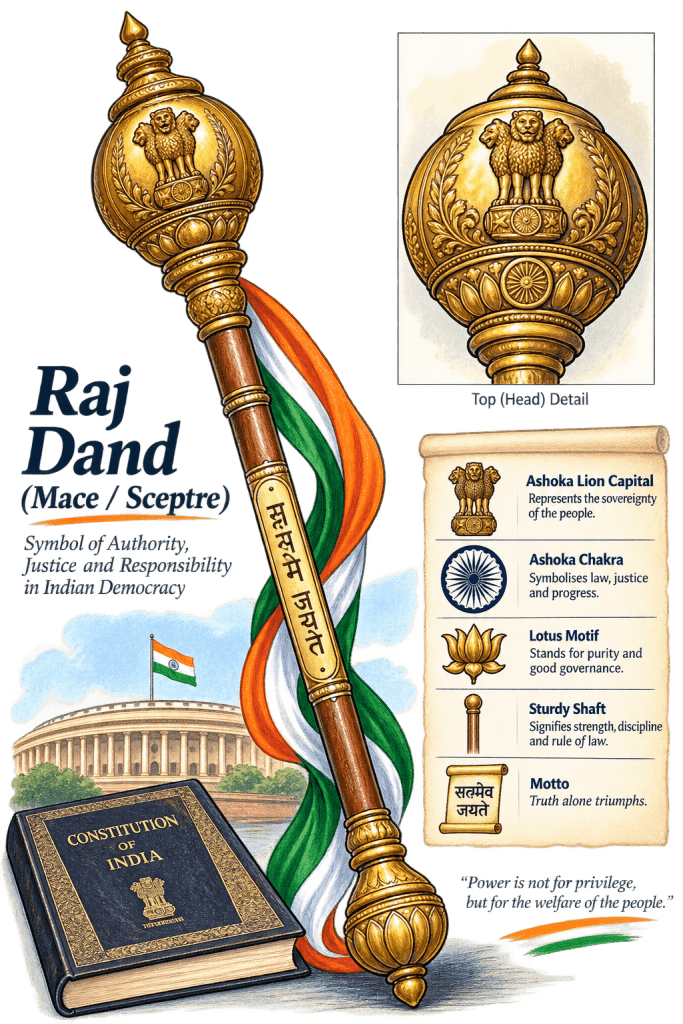
Two incidents reported in the past few days offer a telling glimpse into the direction in which our system is moving- and the state it is in. In Vasai, 77-year-old Jayram Valvi sat in protest outside the tehsil office, holding Rajdanda – royal sceptre in his hand. Only then was his Aadhaar card, which had remained inactive for two years, finally activated.
In another case, the Bombay High Court took strong exception to the Slum Rehabilitation Authority’s (SRA) failure to allot rehabilitation homes to several families, despite repeated assurances. The moment the court reprimanded the officials and initiated contempt proceedings, the allotment of flats began.
These two incidents should concern us deeply
In the first case, a 77-year-old tribal man from the Nalasopara area had been making repeated trips to the tehsil office for two years. His benefits had been stopped because his Aadhaar card was inactive. Tribals have a deep and legitimate claim to this country. The very term Adivasi denotes indigenous people, who are mostly settled in and around forests. They have traditionally lived far removed from the glitter and conveniences of urban life. The facilities and benefits extended to them by the government are not acts of charity, but they are their rights. The sacrifices made by these communities are enormous.
At their core, tribal communities are deeply connected to nature and have traditionally been nature worshippers. Their social structures could not easily be fitted into rigid categories of caste and religion. Their classification evolved largely from their distinct ways of life, livelihoods and customs.
There is no reason to assume that the lifestyle of tribal communities in Thane and Palghar, close to Mumbai, is identical to that of their counterparts in Nandurbar, Dhule or Nashik. The same diversity can be seen among tribal communities in Melghat and Dharni in Amravati, Korchi and Aheri in Gadchiroli, and Kinwat in Nanded. Their contributions across various fields are equally significant.
Tribal Benefits Are Rights, Not Favours
The concessions and benefits provided to tribal communities by the government are not favours, but they are their rightful entitlements.
Tribal communities have surrendered land for Mumbai’s water supply and infrastructure projects, making significant sacrifices in the process. Similar stories can be found across other parts of the state. Their traditional rights over forest land have been substantially curtailed thanks to various legislations and the projects launched by successive governments.
At the same time, there is some truth in the allegation that unscrupulous individuals sometimes exploit similarities with other communities to wrongfully claim benefits intended for genuine tribal beneficiaries. Yet the larger reality remains that deprivation among tribal communities has still not ended.
Against this backdrop, the failure of the administration to show even basic sensitivity towards them, or to ensure their rightful entitlements, must be seen as a serious failure of governance.
It took Valvi spending an entire night sitting outside the Vasai tehsil office, sceptre in hand, for the administration to finally act and restore his Aadhaar card. The incident says a great deal about how the government machinery responds to the ordinary citizen.
Shelter Is a Fundamental Right
The second incident concerns four families from Sion-Koliwada who had been waiting for homes to which they were entitled. In 2011, these families vacated their slums to make way for rehabilitation and moved into a transit camp. The rehabilitation building was eventually constructed, but the families continued to wait for their homes.
After knocking repeatedly on the doors of the Slum Rehabilitation Authority (SRA) without success, they approached the Bombay High Court. Despite several assurances from the SRA, their grievances remained unresolved. It was only after the court expressed its anger and took a stern view against the officials concerned that the families finally received their homes.
Together, these two incidents raise a disturbing question- Is the machinery of government increasingly serving only a select few?
For the exploited and the deprived, does the system have any room left?
If, nearly 80 years after Independence, ordinary citizens still have to run from pillar to post to secure their basic rights, one must ask: Whom exactly is the government machinery working for?
When will the functioning of the administration be seriously reviewed, particularly when there appears to be a growing lack of coordination and accountability within the system?
Several Decisions Only After the Pune Protest
A few days ago, tribal students staged a protest in Pune to press for their demands. The government was eventually forced to take notice. After the matter reached the High Court, Chief Minister Devendra Fadnavis held a meeting.
The government has now decided to begin recruitment to fill up over 12,000 vacancies in the Tribal Development Department.
There have also been numerous complaints about conditions in hostels for tribal students. The existing Direct Benefit Transfer (DBT) arrangement for meals is now set to be discontinued, with mess facilities to be introduced instead.
The message is difficult to miss- the government machinery became active only after the students protested and the courts intervened.
Is that how a responsive democracy is supposed to function?
The British Introduced Checks and Balances
Our democratic system is built on the principle of checks and balances. Interestingly, the British also introduced similar mechanisms into the administrative structure.
The institution of the District Magistrate was created, among other reasons, so that people would not have to approach the police for every problem arising in their daily lives. The District Collector and District Magistrate came to be regarded as the heads of the various administrative agencies within their respective districts.
Whether these officials still exercise all the powers vested in them, or are actually permitted to exercise them, is another matter altogether.
If ordinary citizens are denied basic services or face persistent administrative difficulties, the District Collector has the authority to intervene and direct the concerned department to act.
This was a carefully designed administrative mechanism. The government should protect it and ensure that District Collectors exercise the authority available to them.
Instead, the situation appears to have turned on its head.
Political leadership does not seem to want powerful or independent officials at the district level. A system has gradually emerged in which citizens are expected to repeatedly knock on the doors of local political leaders for their basic needs and even routine government work.
And because citizens themselves have shown little inclination to understand how democratic institutions are supposed to function, they have increasingly begun accepting this change in silence.
Decisions Must Be Taken at the Local Level
Because of certain shortcomings in the revenue administration, some of the powers traditionally associated with the District Magistrate have effectively shifted to the police in areas governed by Police Commissionerates.
This is deeply problematic and contrary to the fundamental spirit of democratic governance. Yet remarkably, there appears to be little public discussion about it.
District Magistrates should not regard it as a matter of pride that people within their jurisdiction are forced to take to the streets or approach the courts merely to secure basic rights and services.
At the very least, the administration must remain particularly vigilant when it comes to the most vulnerable sections of society. Democracy is meant to provide the weak with the same protection that it provides the powerful.
Yet we are beginning to neglect the very foundations of our democratic system.
The consequences of doing so could be serious, and we may not fully appreciate them until it is too late.
Not every citizen can travel to Mumbai, the state capital, to seek justice. Nor can everyone afford to knock on the doors of the High Court.
That is precisely why the administrative system was designed with rules, responsibilities and powers at different levels of government. If those powers are properly exercised, officials are given clear and firm instructions, and their functioning is reviewed periodically, many grievances could be resolved quickly and locally.
What is required is not a new system, but the will to make the existing system work.
Today, citizens are increasingly finding themselves compelled to take to the streets even for relatively small issues. If the belief takes root that the government machinery will not move unless people protest, the consequences for democracy could be deeply damaging. We should recognize one simple truth: when institutions stop responding to citizens, eventually everyone pays the price.