Do Politics, But Develop Dairy Business Too!
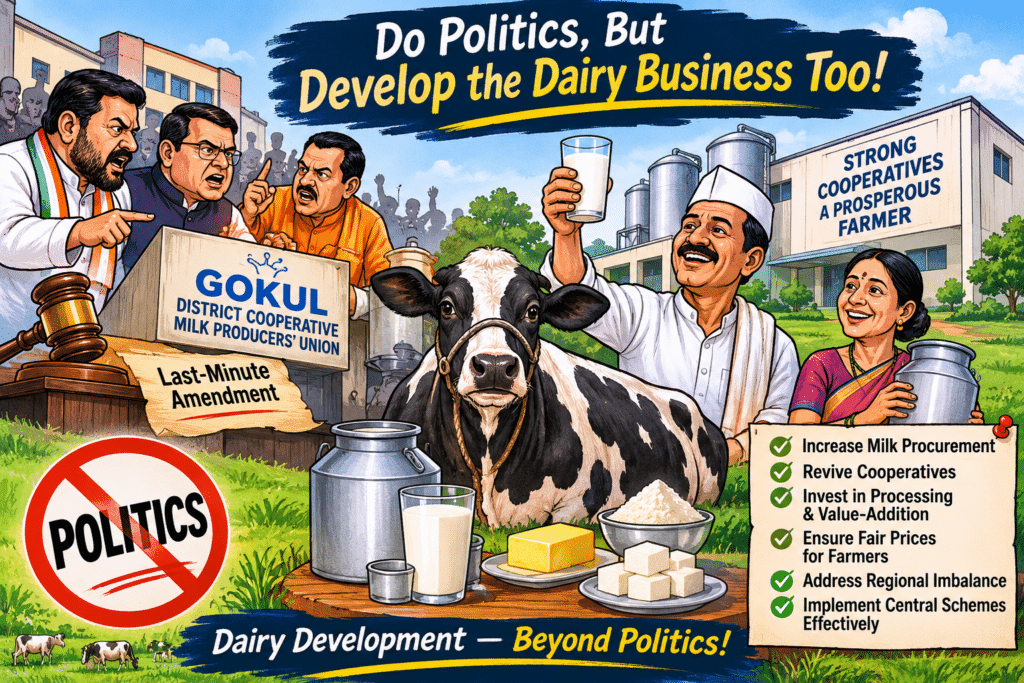
The election to the Kolhapur District Cooperative Milk Producers’ Union, popularly known as Gokul, has stirred up Maharashtra’s political landscape. Just when it appeared that the Congress-backed alliance would wrest control of the institution, the BJP-led Mahayuti government made a political manoeuvre to take over the cooperative, which has an annual turnover of more than ₹4,000 crore.
The government appeared determined to capture Gokul at any cost. The panel led by Congress leader Satej alias Bunty Patil had taken the lead, winning 13 seats. However, a last-minute amendment to the law deprived it of an opportunity to assume power. The move has triggered strong reactions from different quarters.
Political battles often push fundamental issues into the background. Milk is an essential commodity and an important source of supplementary income for farmers. Yet, in the political tug-of-war, farmers’ interests have consistently taken a back seat. Western Maharashtra has been a notable exception to some extent.
Maharashtra’s dairy sector presents a paradox. Although milk production in the state has grown faster than the national average over the past five years, its performance in milk procurement, expansion of the cooperative network and growth of the processing industry remains far from satisfactory.
The cooperative dairy movement, which once played a pivotal role in rural Maharashtra’s economic development, is increasingly losing ground to the private sector. This raises a crucial question: Are milk producers actually benefiting from the increase in production?
An examination of figures in the Union Government’s Department of Animal Husbandry and Dairying Annual Report for 2025–26, along with the state’s dairy sector performance over the past five years, highlights the challenges facing the industry.
Maharashtra’s milk production stood at approximately 13.7 million metric tonnes (MT) in 2020–21. By 2024–25, it had risen to 16.63 million MT, registering growth of about 21.3 per cent over five years.
During the same period, India’s milk production increased from 210 million MT to 247.9 million MT, a growth of 18.1 per cent. Maharashtra has, therefore, outperformed the national average. The state accounts for approximately 6.7 per cent of India’s total milk production.
India is the world’s largest milk producer, accounting for nearly 25 per cent of global production. Dairy farming is vital to rural household incomes, particularly for small and marginal farmers and women, for whom it offers an avenue of economic independence. In a largely rain-dependent state like Maharashtra, it is an important source of regular supplementary income.
However, a significant gap has emerged between rising milk production and procurement through cooperative institutions. According to the state government’s Dairy Development Department, daily milk procurement in the organised sector stood at approximately 13.4 million litres in July 2023.
Private dairies accounted for nearly 9.6 million litres, while cooperative institutions collected just 3.8 million litres. Thus, the private sector commanded more than 71 per cent of organised milk procurement.
The cooperative sector’s performance is particularly concerning. Daily milk procurement by Maharashtra’s cooperative institutions stood at approximately 3,865 tonnes in 2021–22. By 2025–26, it had risen to 4,169 tonnes, an increase of just 7.9 per cent.
In contrast, cooperative milk procurement at the national level grew by 16.7 per cent during the same period. Moreover, Maharashtra’s cooperative procurement declined from 4,385 tonnes in 2024–25 to 4,169 tonnes in 2025–26. This indicates that the cooperative procurement network is failing to keep pace with the growth in milk production.
The expansion of private dairies is not necessarily a negative development. Competition gives farmers alternative markets for selling their milk.
However, a continued decline in the financial and commercial strength of cooperatives could weaken their ability to safeguard milk producers’ collective interests. Cooperative institutions must, therefore, move beyond milk procurement and strengthen their capabilities in processing, branding and marketing.
Maharashtra’s performance under the Union Government’s National Programme for Dairy Development (NPDD) also merits attention.
According to figures up to December 2025, daily milk procurement in Maharashtra increased by 192.89 tonnes under the programme. As many as 369 milk cooperative societies were newly established or revived, while 35,360 farmers were added as members.
However, the programme did not create any additional milk-processing capacity in the state. In comparison, daily milk procurement increased by 4,215 tonnes in Gujarat, 1,561 tonnes in Karnataka and 767 tonnes in Bihar. Although these figures relate specifically to the programme, they highlight the limitations of its implementation in Maharashtra.
Regional disparities in dairy development are another cause for concern. In 2022–23, approximately 45.6 per cent of Maharashtra’s total milk production came from the Pune division, followed by Nashik and Chhatrapati Sambhajinagar.
Irrigation facilities, agricultural prosperity, an extensive cooperative network and access to processing industries have helped western Maharashtra develop a relatively strong dairy sector. In contrast, Marathwada and Vidarbha have considerable untapped potential.
In districts such as Latur, Beed, Dharashiv, Parbhani, Nanded and Hingoli, expanding dairy farming could provide farmers with a reliable source of regular income. However, development plans must account for the availability of water and fodder, improved cattle breeds, veterinary services, milk collection centres and chilling facilities.
The crucial question is whether the political establishment is making a sincere effort to address these requirements.
The economics of dairy farming is equally important. Rising costs of animal feed, fodder, veterinary treatment, labour, and transportation make it essential for farmers to receive remunerative prices for their milk. Transparent pricing based on quality and timely payments are equally important.
Improving animal productivity through better breeds, artificial insemination, scientific feeding practices and disease-prevention measures must also be a priority.
This sector has been so neglected in Maharashtra that, at one point, animal husbandry and dairy development were assigned to two different ministers as separate portfolios. In other words, one minister was expected to look after the animals and another to manage the milk business!
Alongside increasing milk procurement, Maharashtra must invest in processing and value-addition facilities. Producing milk powder, cheese, butter, paneer and curd can open up new markets and generate additional revenue.
The milk producer company model promoted through the National Dairy Development Board (NDDB) could also offer valuable lessons for Maharashtra. According to Central Government figures, approximately 2.46 lakh milk producers are associated with 24 such companies across the country, nearly 79 per cent of them women.
Under the Union Government’s White Revolution 2.0 initiative, the target is to increase milk procurement through cooperative institutions by 50 per cent over the next five years. Maharashtra must seize this opportunity by prioritising the revival of cooperatives, setting up modern processing facilities, introducing professional management and encouraging farmer-owned milk producer companies.
The challenge before Maharashtra is not merely to increase milk production but to establish an efficient and integrated supply chain covering production, procurement, processing and marketing.
Dairy development must extend beyond western Maharashtra. Separate regional strategies are needed to unlock the sector’s potential in Marathwada and Vidarbha.
But none of this will be possible unless politics is kept out of the dairy business.