
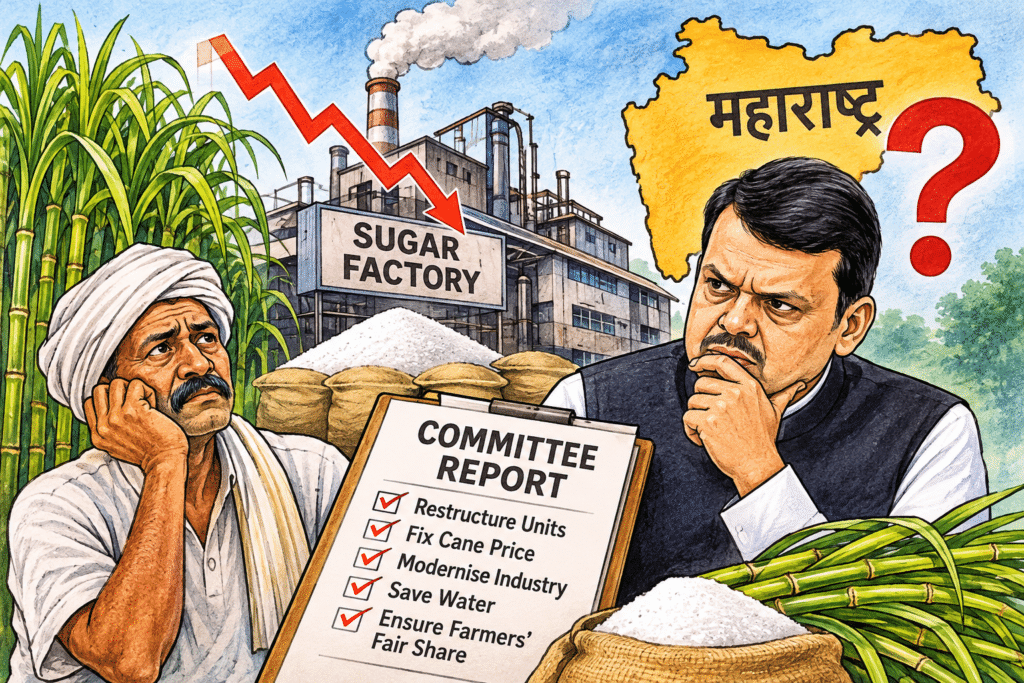
Has the State Surrendered Before the Sugar Industry?
The state government recently decided to appoint a 14-member committee under the Sugar Commissioner to study the problems confronting the sugar industry and recommend remedial measures. The decision is bound to raise eyebrows among observers and experts familiar with Maharashtra’s sugar sector.
After all, several influential political leaders in Maharashtra have spent decades associated with the cooperative movement and the sugar industry. It would be difficult to believe that they are unaware of the sector’s structural and financial problems. Yet, if the government now finds it necessary to appoint another committee and seek fresh recommendations, does it amount to an admission that it has run out of solutions to the industry’s mounting problems?
An Industry in Decline
Government data indicate that over the past 25 years, the number of sugar factories actually crushing sugarcane has declined from around 200 to fewer than 100. Only 75 cooperative sugar factories continue to operate independently. Several have been liquidated or sold, while approximately 30 to 32 cooperative factories are being run by private entities under lease or partnership arrangements.
The sugar industry remains a major pillar of Maharashtra’s rural economy and political landscape. Nearly 30 to 40 lakh farmers are associated with sugarcane cultivation, while the industry’s direct and indirect annual turnover is estimated to exceed Rs 1 lakh crore. Maharashtra accounts for nearly one-third of the country’s sugar production.
Over the decades, the industry has also contributed to the development of educational institutions, hospitals, cooperative consumer societies, lift irrigation schemes and agricultural service centres across rural Maharashtra. Sugar cooperatives have, in many regions, shaped the economic, social and political landscape of rural communities.
Given its enormous economic and social significance, the industry’s declining fortunes are a matter of serious concern. The Sugar Commissioner’s office is expected to play not only a regulatory role but also a developmental one. This raises a fundamental question: What concrete measures have been undertaken so far to arrest the industry’s financial deterioration and improve its operational efficiency?
The Government’s Financial Support Model
Over the past two years, financial assistance has been extended to 33 cooperative sugar factories through the National Cooperative Development Corporation (NCDC), with state government guarantees. The government maintains that this intervention helped prevent the closure of several factories and ensured that the number of operational units did not decline further.
However, financial assistance has not necessarily translated into a sustainable turnaround for these factories. There is an increasing expectation that the state government, in collaboration with the Maharashtra State Cooperative Bank, should devise a viable and independent financial model to ensure the long-term survival of cooperative sugar factories.
The newly appointed committee will also have to address several longstanding issues. These include determining sugarcane prices in relation to sugar recovery rates, aligning crushing capacity with the available crushing season, and establishing rational norms for sugarcane transportation costs, particularly where restrictions imposed by designated factory zones compel farmers to transport cane over longer distances.
These are not new challenges. What is required is a practical framework that can address them without perpetuating the industry’s dependence on financial assistance.
Dozens of Reports, Few Solutions
The sugar industry has been examined by numerous committees appointed by both the Centre and the state government. At the national level, committees headed by C. Rangarajan, Dr Bhargava, Dr Yashwantrao Thorat, Dr Mahajan, Dr T. Jacob and Dr Tuteja have examined different aspects of the industry’s functioning.
In Maharashtra, committees headed by Dr Madhav Godbole and Dr Shivajirao Patil, among others, have made recommendations on various issues. As many as nine reports have also been submitted on matters concerning the final payment of sugarcane prices.
More recently, in March 2020, NITI Aayog undertook an extensive examination of the sugarcane and sugar industry and proposed several significant reforms.
Yet, there is no readily available comprehensive account of how extensively these reports were debated in the state legislature, how many recommendations were accepted, or what policy interventions followed.
Before another committee embarks on a fresh exercise, the government must explain what happened to the recommendations of its predecessors. The absence of a clear assessment of past interventions raises questions about the purpose and effectiveness of repeated committee appointments.
NITI Aayog’s Reality Check
NITI Aayog’s observations on Maharashtra’s sugar industry are particularly significant. Rather than advocating the expansion of sugar factories, the report stressed the need to restructure existing units financially, modernise their technology and improve resource utilisation.
The industry’s biggest financial challenge is the widening gap between the cost of sugarcane procurement and the revenue generated from the sale of sugar. While the Fair and Remunerative Price (FRP) payable to sugarcane farmers has steadily increased, the Minimum Selling Price (MSP) of sugar has not kept pace.
According to the report, the average cost of sugar production was Rs 35.80 per kilogram, against an MSP of Rs 31 per kilogram. It recommended raising the MSP to Rs 33 per kilogram.
The report also proposed alternative revenue-sharing mechanisms, including allocating 75 per cent of the revenue generated from sugar and its by-products to farmers, or 80 per cent of the revenue generated from sugar alone.
To ease the financial burden of FRP payments, it recommended the creation of a separate price stabilisation fund and allowing FRP payments to be made in instalments over two months.
It further proposed establishing a Rs 4,500-crore fund to modernise sugar factories and clear pending payments to farmers. However, the report underscored that financial assistance alone would not resolve the industry’s problems. Improved operational efficiency, professional management and better financial discipline were equally essential.
Marathwada, Vidarbha and the Water Question
One of NITI Aayog’s most significant observations concerning Maharashtra relates to the expansion of sugarcane cultivation in Marathwada and Vidarbha, despite the water scarcity confronting these regions.
Sugarcane cultivation expanded in western Maharashtra, supported by relatively favourable rainfall, rivers, dams and irrigation infrastructure. However, large parts of Marathwada and Vidarbha continue to face recurring water shortages.
Despite these constraints, assured prices, guaranteed procurement by sugar factories and local economic interests have encouraged the expansion of sugarcane cultivation in water-stressed areas.
According to NITI Aayog’s observations, nearly 70 per cent of the agricultural water consumed in Marathwada and Vidarbha is used for sugarcane cultivation.
The report also highlighted the stark differences in water consumption and productivity. Pre-seasonal sugarcane in Maharashtra requires approximately 3.6 times as much irrigation water as sugarcane in Uttar Pradesh, while the water requirement for adsali sugarcane is around 4.3 times higher.
In terms of water-use efficiency, Uttar Pradesh produces 9.60 kg of sugarcane per cubic metre of water, compared with just 5.94 kg per cubic metre for pre-seasonal sugarcane in Maharashtra.
The report advocated greater adoption of drip irrigation, observing that it could save 40 to 50 per cent of water and improve productivity by approximately 30 per cent.
The cost of harvesting labour and transportation also significantly affects farmers’ actual earnings. These issues need to be examined independently and addressed through practical interventions.
The Questions Maharashtra Must Answer
The fundamental policy question confronting Maharashtra is whether it should continue expanding the sugar industry or prioritise restructuring existing factories, taking into account the availability of sugarcane, water resources and financial viability.
The contribution of cooperative sugar factories to rural development cannot be dismissed. However, the industry cannot remain indefinitely dependent on government guarantees, loans, subsidies and financial rescue packages.
Financial discipline, professional management, technological modernisation and efficient water utilisation must become central to the industry’s revival.
Sugar factories must also move beyond sugar production and diversify their revenue streams through ethanol, cogeneration of electricity and other value-added products. Such diversification must be backed by viable business models rather than merely being presented as another avenue for financial assistance.
The problems confronting the sugar industry are hardly unfamiliar to the political leadership associated with it. Decades of experience in the cooperative movement, along with the recommendations of numerous committees, should have provided sufficient understanding of the challenges and possible solutions.
What, then, has been achieved?
Instead of merely submitting another report, the new committee should also examine why earlier recommendations were not implemented, identify institutional and policy failures, and establish a time-bound roadmap for reform.
Otherwise, committees will continue to be appointed, and reports will continue to be submitted, while the structural, financial and managerial ailments of Maharashtra’s cooperative sugar industry remain unresolved.
That is why the question of whether the state’s political leadership has surrendered before the sugar industry is becoming increasingly relevant.