

Who Is More Powerful: The Cabinet or the Chief Minister?
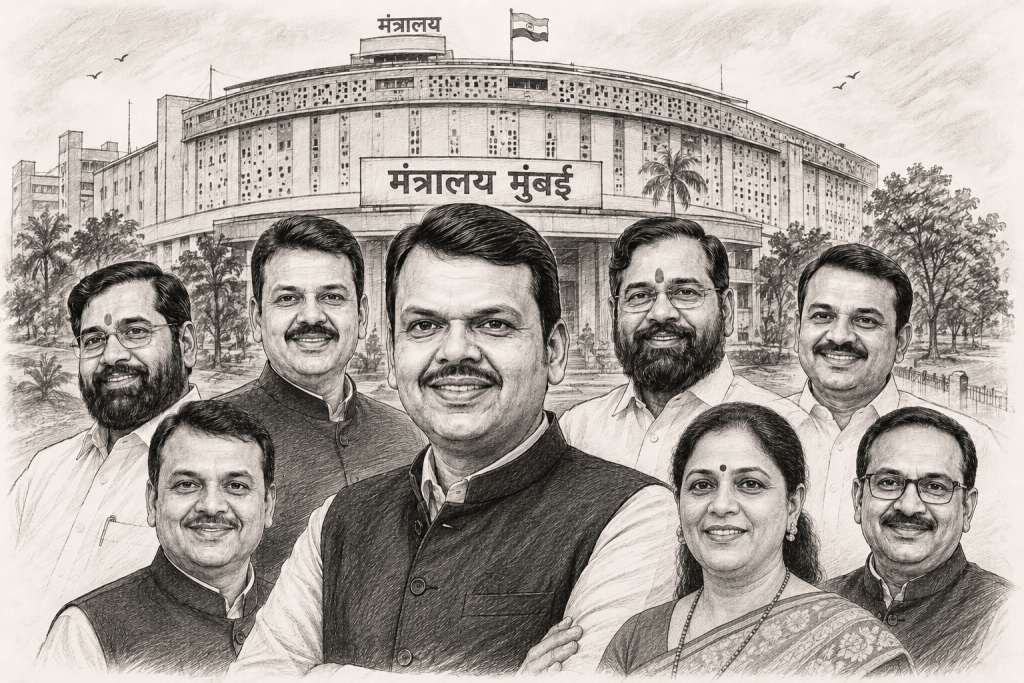
The institutions, be they governmental, semi-governmental, or private, are governed by certain rules. The government, too, operates according to rules and laws. It is accountable to the people, and the manner in which it functions is prescribed by law.
Each government department follows rules specifying the responsibilities it must discharge and the procedures it must follow. Almost all state departments follow manuals that set out their duties and functions in accordance with the law. They also follow mandated guidelines for delivering services to the public. Sadly, ordinary citizens rarely bother to examine these rules. Instead, they often believe that the best way to get their work done is by meeting higher-ups, whether a government officer or a political leader who controls local or departmental affairs, from the taluka level all the way to Mantralaya.
An elected government decides the direction of governance. The legislature, comprising members from all political parties, is expected to determine and scrutinise that direction. Whether it actually does so is another question. The legislature can scrutinise government rules and legislation and can ask the state government to reconsider or amend them.
Recently, the state government notified the Rules of Business, 2026, amending the earlier set of rules issued in 1975. These rules prescribe how the elected government, the Council of Ministers and its head, the Chief Minister, as well as the administrative head, the Chief Secretary, and other secretaries are to discharge their responsibilities.
One of the most significant changes likely to attract attention is digital governance. The government has adopted the e-office system, and most files are now submitted online. Similarly, the agenda for state Cabinet meetings is forwarded to ministers online. The documents attached to agenda items are no longer presented to ministers in the traditional printed format. If digital technology is being promoted to encourage ministers to embrace the changing times, there could also be a demand that elected representatives in the future should have appropriate education and training to use such technology effectively.
In a democracy, the government functions through the Council of Ministers. The principle that the Chief Minister is primus inter pares—the first among equals—is inherent in the system. In legal and constitutional terms, this means that the Chief Minister occupies the foremost position among the ministers. Over time, however, the office of Chief Minister has become extremely powerful. The position has acquired a range of powers, partly because of the authority and respect accorded to it. Not all these powers were necessarily conferred expressly by law; some evolved from established conventions and administrative practice. As the head of government, the Chief Minister has traditionally been the focal point for crucial matters of state administration, many of which were required to be placed before the Chief Minister as part of the established procedure.
The new rules give legal backing to many such practices, making the office of the Chief Minister more powerful. The rules governing government business for more than five decades have now been replaced by a more comprehensive framework. The new rules make the roles of the Chief Minister and the Chief Secretary clearer and more effective. The functioning of the Cabinet, norms governing financial procedures, and digital administration have also been brought within a formal regulatory framework.
The Chief Minister presides over Cabinet meetings, while the Chief Secretary serves as Secretary to the Cabinet. The Chief Secretary and other secretaries have the right to express their views, as they are responsible for implementing decisions taken by the government.
The Importance of the Chief Secretary’s Office
The new rules provide greater clarity regarding the institutional role of the Chief Secretary. The Chief Secretary has been given a distinct position, with the scope and responsibilities of the office clearly defined.
Every proposal placed before the Cabinet must be submitted through the Chief Secretary. If a proposal involves a draft law, violates existing rules, or is inconsistent with government policy, the Chief Secretary is expected to bring the matter to the attention of the Chief Minister or the concerned minister.
The rules also provide for the creation of an empowered committee headed by the Chief Secretary, Additional Chief Secretary, or Principal Secretary to deal with a particular matter and take a final decision. This means that such a committee is not merely required to examine a matter and record its views; it could reasonably be argued that, where the rules confer decision-making authority upon it, the government would ordinarily be expected to abide by its decision.
Chief Minister’s Powers Expanded
The Chief Minister’s coordinating powers have also been explicitly strengthened. Under Rule 13(5), if the Chief Minister considers it necessary in the public interest, he may, after recording reasons in writing, set aside a decision taken by a minister. However, this power does not extend to quasi-judicial matters.
The apparent reason for excluding such matters is that ministers’ powers to conduct hearings and issue decisions are prescribed by law. Moreover, in many cases, decisions taken by ministers can be challenged before the courts.
Under the existing rules, if a department is not assigned to any minister, it is deemed to be under the Chief Minister. Greater clarity has now been introduced on this point. If, in a minister’s absence, the subjects handled by that minister are assigned to another minister, the Governor must also be informed.
More Detailed Rules for the Cabinet
The new rules clarify the distinction between the Cabinet and the broader Council of Ministers. The Cabinet will consist of ministers other than Ministers of State. However, the Chief Minister may invite Ministers of State to attend Cabinet meetings whenever necessary.
A Cabinet subcommittee may be constituted for a particular matter. Its composition and powers are to be determined at a Cabinet meeting. Decisions taken by such a committee are treated as decisions of the Cabinet. This arrangement has now been formally incorporated into the rules.
The rules also provide for online Cabinet meetings. If urgency requires, decisions taken in such meetings can be implemented without formal approval of the minutes by Cabinet members. In other words, the Chief Minister will now be able to convene Cabinet meetings online and have decisions taken at those meetings implemented without waiting for the formal approval of the minutes.
Financial Limits for Cabinet Approval Changed
The new rules establish updated financial thresholds for government transactions. Proposals involving the sale of government property valued at more than Rs. 25 lakh, or proposals to provide such property by way of grant or lease, will generally have to be placed before the Cabinet.
Similarly, decisions involving the foregoing of revenue between Rs. 25 lakh and ₹50 lakh will have to be brought before the Cabinet. The implication is that the financial freedom of individual departments has been tightened, with more matters being brought within the Cabinet’s purview.
Broader Role for the Planning and Finance Departments
The Planning and Finance departments have a greater role in dealing with Cabinet proposals. The Planning Department is responsible for consultation, assessment of potential consequences, public-private partnerships (PPPs), special purpose vehicles (SPVs), and scrutiny of infrastructure-related matters.
The Finance Department’s central role in providing financial advice has been retained, while its responsibilities relating to loans, guarantees, borrowings, taxation, the budget, auditing, government receipts, and reappropriation have been set out in greater detail.
For proposals with financial implications, the rules require the proposal to be submitted as a single file, along with the views of the concerned departments. This is intended to reduce the number of parallel files and minimise conflicting departmental positions.
The larger question, therefore, is whether these rules merely bring existing administrative practices into a formal framework or whether they fundamentally alter the balance of power within the government. On paper, the Council of Ministers remains the government and the Chief Minister remains primus inter pares. But by formally expanding the Chief Minister’s coordinating authority, strengthening the role of the Chief Secretary, and tightening the procedures through which important matters reach the Cabinet, the new Rules of Business could significantly strengthen the institutional authority of the Chief Minister.
The answer to the question of who is more powerful—the Cabinet or the Chief Minister—may therefore depend not merely on what the Constitution or the rules say, but on how these powers are exercised in practice.