
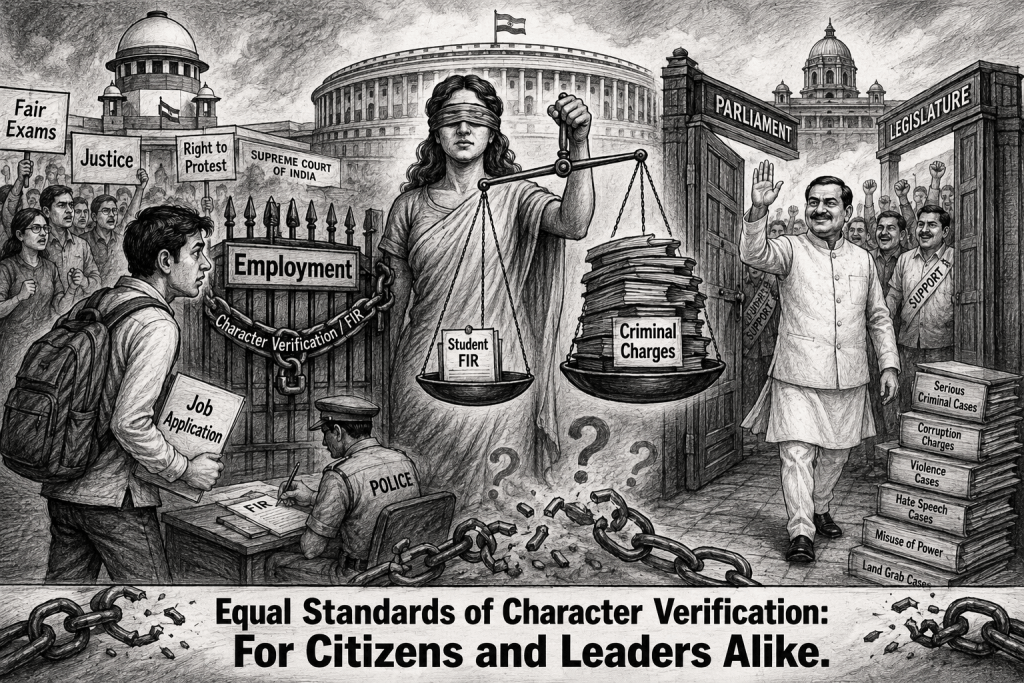
Character Certificate Should Be Mandatory for All!
The issue of the criminal cases registered by the police against young protesters, particularly the Gen-Z protesters in Delhi and other parts of the country, is currently before the Supreme Court of India. Although the Devendra Fadnavis-led government in Maharashtra has directed the police not to proceed with such cases, a legal complication remains. It is being discussed within government circles that while no charge sheet will be filed in these cases, the First Information Reports (FIRs) will remain on record.
This means that no criminal trial will proceed in court. However, since the FIRs would continue to exist, they could still adversely affect these young people’s employment prospects and access to various opportunities. If the Supreme Court addresses this issue comprehensively in its judgment, it would provide immense relief to students across the country.
This concerns character verification certificates for students. Another equally important question is why such character verification should not apply to those in politics. Before that, it is worth discussing government recruitment.
For virtually every government job, from a peon to an officer, character verification is an essential part of the recruitment process. Since police recruitment is often conducted more quickly than hiring in other government departments, many young people dedicate themselves to preparing for these positions. However, if an FIR has been registered against someone, obtaining a character certificate becomes difficult, whether for a government job or even for employment in the private sector. Those who had criminal cases registered against them merely for participating in protests at places like Jantar Mantar or elsewhere are likely to face obstacles in obtaining such certificates until those are formally withdrawn.
Character Verification Should Apply to Public Life Too
While the state and central government claim to be undertaking various welfare schemes for young people, it is contradictory to simultaneously keep them under the shadow of criminal cases simply because they protested over the irregularities in competitive examinations. The original purpose of such protests is important.
In reality, character verification should not be limited to employment alone; it should also be considered essential for those serving in public life. Many controversial individuals continue to occupy influential public positions. Assigning them important responsibilities merely because it is politically convenient raises serious ethical questions.
A recent example is that of Kalyan-Dombivli Municipal Corporation member Ramesh Mhatre, who assaulted doctors and nurses at a municipal hospital. The Bombay High Court took serious note of the incident, cancelled the bail granted by the lower court, and sent the corporator back to prison. Reports that multiple serious criminal cases were already pending against him also became a matter of public discussion.
Different Standards for Politicians and Young People
Individuals facing numerous serious criminal charges can continue to enjoy public respect and even serve in legislative bodies such as Parliament or state assemblies. They are not required to obtain character verification certificates, nor does such verification determine their eligibility. Some politicians have even contested elections while in prison.
Meanwhile, young people may lose access to employment simply because of an FIR. This disparity is troubling.
A closer look reveals that 46% of Members of Parliament have declared pending criminal cases against themselves, with 31% facing serious criminal charges. These lawmakers continue to participate in making the nation’s laws, while young people with criminal records arising from protests may struggle even to secure a livelihood.
Many Legislators Face Criminal Charges
According to the Association for Democratic Reforms (ADR), 58% of members of the Maharashtra Legislature have criminal cases pending against them. The organisation reached this conclusion after examining the election affidavits of 286 legislators. Of these, 40% face serious criminal charges.
Whether in Parliament or a state legislature, politicians often argue that merely having a criminal case registered does not make someone guilty until the charges are proven. Even if one accepts that argument, the same standard should apply equally to young people trying to build their futures.
Politics is not some sacred field exempt from principles that apply elsewhere. There is no justification for imposing one standard on aspiring professionals and another on elected representatives.
Peaceful Protest Is Not the Same as Criminal Intent
There is a clear difference between a deliberate criminal act and an offence that arises when a peaceful protest unexpectedly takes a different turn. In a democracy, expressing dissent against the government, staging demonstrations, or holding peaceful protests should not be regarded as serious crimes.
However, because police often lack clear guidelines, protesters frequently face criminal charges for allegedly obstructing traffic, assembling unlawfully, protesting without permission, or violating procedural rules. It is the protesters who bear the consequences.
Ideally, a democratic government should ensure that public dissatisfaction does not escalate. When public resentment over an issue becomes apparent, institutions should be capable of resolving the impasse. Instead, governments often focus on preventing any organised opposition from emerging and seek various means to suppress it.
What Standards Govern Police Action?
There are established legal procedures governing the use of force by the police. If a situation is likely to go out of control and force becomes necessary, the District Magistrate must be consulted and authorise its use. In rural and semi-urban areas, the District Collector serves as the District Magistrate. In cities with Police Commissionerates, such as Mumbai, Thane, and Pune, these powers rest with the police themselves, creating a significant contradiction.
Yet, if someone were to ask what legal procedures were followed, what criteria were applied, or demand written orders authorising the use of force during a protest, they would likely be dismissed rather than given answers.
The Need for Uniform Ethical Standards
Ultimately, character verification should apply across all sectors, not selectively.
A famous line from Shakespeare states that “Caesar’s wife must be above suspicion.” The essence of this idea is that individuals in public life, whether they hold official office or exercise authority through public trust, must not even create the appearance of wrongdoing.
Ethics should not be applied selectively; they should govern every sphere of public life. In a parliamentary democracy, voters also bear responsibility. Citizens should ensure that the representatives they elect or the leaders they support are not tainted by serious criminal allegations.
Unfortunately, modern politics is increasingly dominated by money power and muscle power, and voters often overlook questions of character and integrity. A notable example was when the controversial Arun Gawli was elected to the Maharashtra Legislative Assembly while Prof. Arun Gujarathi was defeated. At the time, former Home Minister R. R. Patil publicly expressed regret over the outcome.
At the very least, the Gen-Z protests should spark a broader public debate on the need for uniform standards of character verification, standards that apply not only to job-seeking youth but equally to those who seek to govern them.