Opposition Is Not an Institution but a Conception
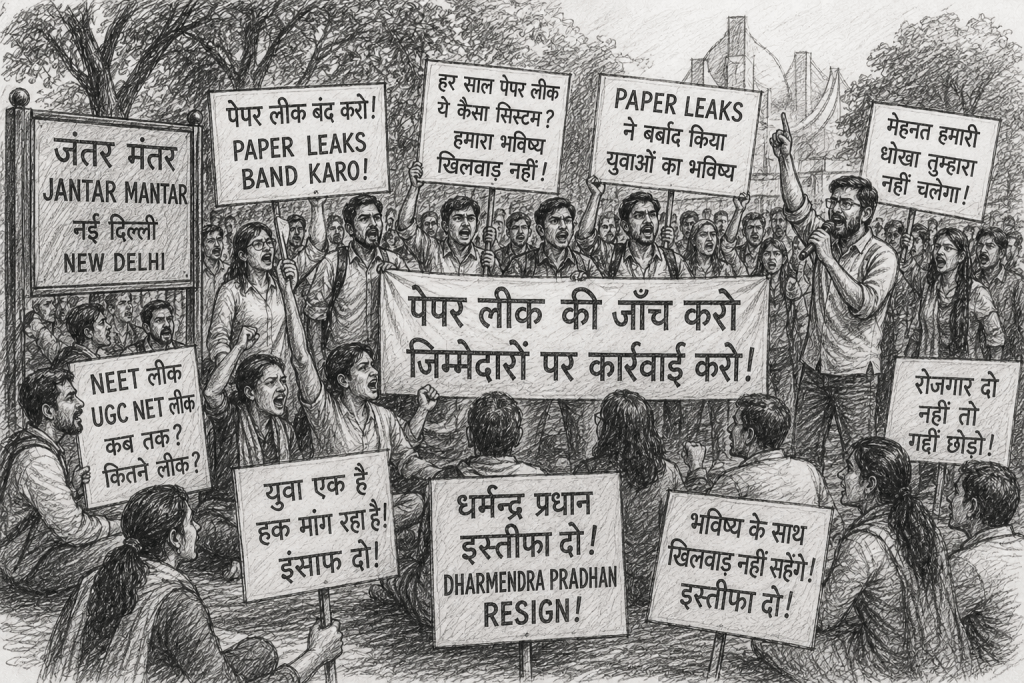
Every year, millions of students prepare for the prestigious NEET examination. This year’s examination, however, became mired in controversy after allegations of a paper leak, eventually leading to a re-examination. Around the same time, a social media platform operating under the banner of the “Cockroach Janata Party” began attracting widespread attention. Although it is not an officially registered political party with the Election Commission, it sought to articulate questions and anxieties that resonated with today’s youth. That alone was enough to draw thousands of young supporters.
As anger over the NEET controversy intensified, frustrated students increasingly turned to the social media platforms associated with the Cockroach Janata Party. What began as an online campaign soon evolved into a full-fledged public movement.
The First Major Protest Outside the Traditional Political Framework
The protest that began in Delhi a few days ago, strengthened by the participation of Sonam Wangchuk and amplified through social media, soon became influential enough that traditional media appeared almost secondary. The conventional platforms of opposition parties also seemed to lose relevance.
Remarkably, the movement did not initially depend on the support of the Congress, the largest opposition party in Parliament. Instead, public discussion increasingly centred on why Rahul Gandhi had not met Sonam Wangchuk.
In many ways, this may be viewed as one of the first major instances in independent India’s parliamentary history where a nationwide movement gained prominence largely outside the established framework of political parties. It also prompted debate over why the Congress, the principal opposition party in Parliament, was not actively participating in the agitation. At the same time, many young people openly questioned the limitations of the mainstream media, often described as the fourth pillar of democracy.
Until now, India’s democratic practice has generally followed a familiar pattern. Political parties and organised social groups determined which issues became matters of political opposition, while the media largely served as the arena for public debate. Both the ruling party and the opposition selectively embraced issues highlighted by the media when they suited their political interests, while allowing many others to fade from public attention.
The Delhi protest suggested that this pattern may be changing. After initially observing the movement from a distance, opposition parties eventually found it difficult to remain detached. Rahul Gandhi, Sharad Pawar, Uddhav Thackeray, Akhilesh Yadav, Supriya Sule, and several other leaders ultimately visited the protest site at Jantar Mantar.
Opposition Is Not the Monopoly of Political Parties
The movement has challenged the long-standing assumption that only political parties and their leaders possess the authority to oppose those in power. It has also demonstrated that a broad-based public movement cannot simply be extinguished through police action, baton charges, or attempts to disperse protesters.
The Congress’s initial reluctance to take a clear position on either the Cockroach Janata Party or Sonam Wangchuk also became the subject of considerable discussion. Some political observers argued that this hesitation reflected strategic calculations, while others speculated that encouraging a non-party platform for dissent could indirectly weaken the Congress by creating an alternative space for opposition. Whatever the explanation, the perception itself became politically significant.
Within the Congress, there were reportedly concerns that many protesters believed the party was deliberately distancing itself from the movement despite being the country’s principal opposition force. Rahul Gandhi’s subsequent protest outside the Prime Minister’s residence, reportedly without his usual security entourage, was widely interpreted as an attempt to reconnect with the movement and alter that perception.
Over the years, a political convention has taken root in which whatever opposition parties say is automatically regarded as “the opposition,” while broader public opinion is often dismissed as little more than discussion. Political parties have increasingly assumed that only the issues they choose deserve national political attention. Independent movements are either adopted when politically advantageous or ignored in the hope that they will eventually disappear.
The student movement has forced both the ruling party and the opposition to reconsider this assumption. Opposition is neither an institutional structure nor the exclusive property of any political party. It is fundamentally a public sentiment—an expression of collective aspirations, anxieties, and demands. Political parties that fail to recognise these sentiments risk losing their relevance as entirely new forms of public mobilisation emerge.
This Debate Is Far from Over
Anyone who closely observes the current public mood would recognise that the political landscape is no longer defined simply by a powerful government confronting a weak opposition. Nor does this emerging platform of dissent appear likely to disappear easily.
Many citizens who have grown disillusioned with both opposition parties and the mainstream media have now discovered that alternative platforms can capture national attention. The movement has conveyed a broader message: the idea of opposition cannot remain confined to any single political party. It will continue to find new ways of reaching the people.
It also serves as a rebuke to those who repeatedly argue that “the people must now come forward” while avoiding taking a stand themselves.
Those who enjoy institutional protection cannot indefinitely expect ordinary citizens—who possess no such safeguards—to bear the full burden of public protest. Such an approach is neither fair nor sustainable.
The students’ movement has compelled every political party to introspect. For years, political parties have largely determined which issues dominate public discourse, while more fundamental concerns have often remained marginal. Sustained nationwide movements on employment, education, and healthcare—the three issues that affect millions of Indians most directly—have been relatively rare, and those that have emerged have often proved short-lived.
Inflation remains another pressing concern. Although ordinary citizens frequently speak about the rising cost of living, the issue rarely receives sustained political attention. Governments naturally prefer stability and fewer public confrontations, while opposition parties often prioritise issues that best serve their electoral interests. Even the most influential opposition leaders tend to focus on a limited set of subjects within their own political constituencies.
This movement has the potential to alter that political calculation. It has demonstrated that opposition is not something political parties create; rather, it is something they either represent—or fail to represent. If they fail, society will create new platforms to express it.
That is why this movement is unlikely to fade until it produces meaningful political or policy outcomes. More importantly, it has reopened a fundamental democratic question: Who truly owns the idea of opposition—the political parties, or the people themselves?